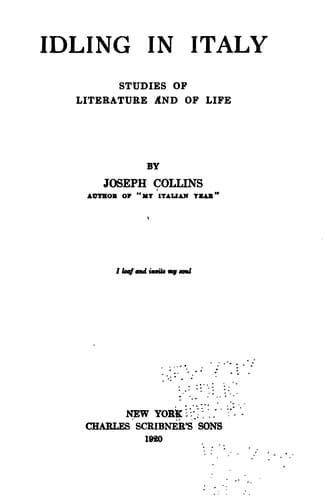
Idling in Italy: Studies of literature and of lifeCollins, Joseph
History
Idling in Italy: Studies of literature and of life
Collins, Joseph
Italian literature -- History and criticism
One of the things that is most difficult to forgive a biographer is the
wealth of sordid details they give us about our gods. Who can forgive
Ranieri, for instance, for having told us with so much particularity
that Leopardi hated to change his shirt or to take a bath, that he had a
passion for cheap sweets, that he insisted upon keeping the servants of
the household where he was a guest up until midnight in order that he
might have his principal meal, that he was morbidly susceptible to
adulation? It does not advantage any one to know such things, even if
they are true, and if it serves any laudable purpose I am not aware that
it has been set forth.
Mr. Jones's biography is painfully candid and distressingly frank and
confidential.
Samuel Butler's life was one of rebellion and resignation, of contention
and strife, of unhappiness and unyieldingness, of disappointment and
suspicion, of wrongheartedness and rightmindedness, of rude energy and
crude revery. He had a vanity of his intellectual capacity that
transcends all understanding and a passion for what he called doing
things thoroughly. He believed in the music of Handel, in the art of
Giovanni Bellini, and his credo was the thirteenth chapter of St. Paul's
First Epistle to the Corinthians, which apotheosizes charity and
humility. Samuel Butler may have had charity and humility on his lips,
but I fail to find from reading his biography that they ever got as far
as his heart. He had an unhappy childhood, a perturbed adolescence, a
lonely and isolated early manhood, an obsessed maturity, and an
emotionally sterile old age. He hated his father, he pitied his mother,
he barely tolerated his sisters, and he suspected the integrity and
motives of his illustrious contemporaries who, though polite to him,
personally ignored him controversially. Indeed, part of the time he must
have felt himself a modern, though tame Ishmael, his hand against every
man, and every man's hand against him.
Although he had a few forgiving, appreciative friends, a constant and
ardent mistress, and a devoted servant who mothered and domineered him,
engrossing interests and boundless energy, still he was chronically
unhappy, the sweetness of his soul being embittered by contempt of his
fellow men.
The offspring of a narrow-minded, obstinate, inflexible, selfish father
and a gentle, reverential, yielding, and kindly mother, it was taken for
granted that he would follow in the footsteps of his father and
grandfather and become a clergyman. He found when he began to take
thought that he could not accept the Christian miracles or believe in a
personal, anthropomorphic God. So he went to New Zealand and became a
successful sheep-grazer, and within five years he had more than doubled
the four thousand pounds which he had been able to screw from his
father.
Public-domain text, read in full here on John Shaqi.
Reviews
Reviews
No reviews yet
Be the first to share your thoughts on this work.
Elsewhere in the archive
Join the Discussion
Join the discussion
Sign in to leave a comment or review.
Sign InorCreate an account