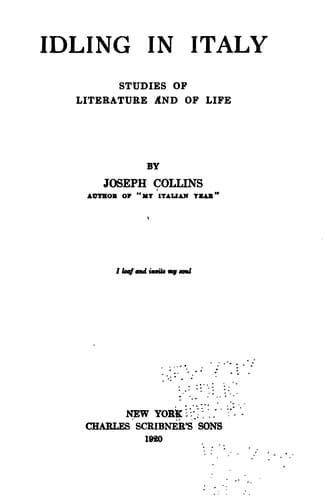
Idling in Italy: Studies of literature and of lifeCollins, Joseph
History
Idling in Italy: Studies of literature and of life
Collins, Joseph
Italian literature -- History and criticism
His life during these years is interesting in so much as it shows how a
man of education and breeding lived in the bush while developing
intellectually. The devil often tempted him there, but not always with
success, though he became terribly fussed over the death and
resurrection of Christ. He thought and wrote about it, but he was not
successfully delivered from his dilemma until the idea of "Erewhon" took
possession of him. This idea was that machines were about to supplant
the human race and be developed into a higher kind of life. When the
conception first seized him he wrote to Charles Darwin, whom he started
by admiring and ended by despising, that he developed it "for mere fun
and because it amused him and without a particle of serious meaning." He
had Butler's "Analogy" in his head as the book at which it should be
aimed, but when "Erewhon" appeared most readers thought he had "The
Origin of Species" in mind.
From this time one begins to see how extraordinarily laborious were all
of Butler's writings. "Erewhon" was not published until eight years
later, during which time he had written and rewritten, corrected and
re-corrected, pruned, elaborated, and incorporated sentences from
letters, records of experiences which he had while prospecting for and
developing his sheeprun, and innumerable notes from a commonplace book
which he early acquired the art of keeping. Ten years after its
publication he wrote to an indiscriminating, ardent admirer: "I don't
like 'Erewhon'; still it is good for me."
The next book he wrote, "The Fair Haven," he liked very much, but few
others did. When he was a very young man he had written a pamphlet on
the Resurrection. He was disappointed that it made little or no
impression. Finally he decided it had been written too seriously. It
then occurred to him to treat the subject as he had treated the analogy
of crime and disease in "Erewhon." The book purports to be written by
the son of a clergyman, the antithesis of Butler's father, insane before
the manuscript was completed, and of a mother, the replica of his own
mother. A brother gives the book to the world, prefixing a memoir of the
author modelled after Butler. The book fell flat. The few who resented
it were the sensitive orthodox whose feelings were outraged. Butler
could not understand why he was unable to induce people to reconsider
the gospel accounts of the Crucifixion and the Resurrection.
The second distinctive characteristic of Butler's make-up was his spirit
of God-I-thank-thee-that-I-am-not-as-other-men.
Public-domain text, read in full here on John Shaqi.
Reviews
Reviews
No reviews yet
Be the first to share your thoughts on this work.
Elsewhere in the archive
Join the Discussion
Join the discussion
Sign in to leave a comment or review.
Sign InorCreate an account