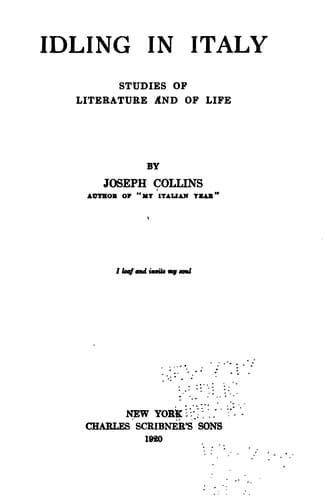
Idling in Italy: Studies of literature and of lifeCollins, Joseph
History
Idling in Italy: Studies of literature and of life
Collins, Joseph
Italian literature -- History and criticism
Butler would seem never to have been in love in the ordinary usual way.
We are justified in concluding that he had only a tenderness for
"Madame," who "during the twenty years of intimacy with Butler had no
rivals." Certainly he never was in love with Elizabeth Mary Ann Savage,
an extraordinary woman whose mentality is reflected in all of Butler's
books. From 1871, when he was writing "Erewhon," until her death, in
1885, Butler submitted to Miss Savage everything he wrote, and
remodelled in accordance with her criticisms and suggestions. Not only
did he submit the drafts of his books to her, but the suggestions of
many of them originated with her. If ever the soul and spirit of one
person operated through another, the soul and spirit of this brilliant
woman operated through the apparent mental elaborations of Samuel
Butler. She understood him as no one else understood him; she loved him
as no other woman loved him. Her devotion to him, her appreciation of
his talent, her unrequited love, her unfailing humor and mirth, her
incomparable courage when confronted with serious disease and with
death, and her apparent willingness that her talent should shine through
him is one of the most extraordinary things in literature. I am at a
loss to understand why neither his biographers nor the critics of
Butler's writings have given the subject adequate consideration.
Some years ago a youthful Austrian psychopath, Weininger, wrote a book,
"Geschlecht und Charakter," which had great popularity. It was widely
read in the original and in translations. Amongst other things that he
discussed was the sex endowment of man. The hundred per cent male is
very uncommon, and he is rarely encountered amongst creative artists.
The feminine percentage in them is considerable, often more than fifty
per cent. Samuel Butler had many feminine traits. He was vain, gossipy,
vindictive, swayed by his emotions, and he allowed himself to be wooed
by a woman. He took from Elizabeth Mary Ann Savage without giving a quid
pro quo or even acknowledgment. He did not have the courage to say to
her in the flesh what he said of her in the grave. He sold to the public
as of his own manufacture the warp and woof of her intellectual
weavings. Her letters, which form such a large part of the first volume
of these memoirs and which Butler wrote to her father "the like of which
I have never elsewhere seen," testify the public debt to her contracted
in the name of Samuel Butler.
Public-domain text, read in full here on John Shaqi.
Reviews
Reviews
No reviews yet
Be the first to share your thoughts on this work.
Elsewhere in the archive
Join the Discussion
Join the discussion
Sign in to leave a comment or review.
Sign InorCreate an account