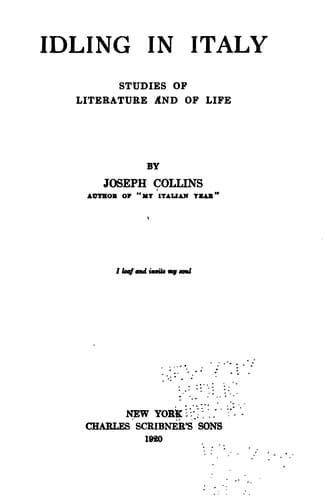
Idling in Italy: Studies of literature and of lifeCollins, Joseph
History
Idling in Italy: Studies of literature and of life
Collins, Joseph
Italian literature -- History and criticism
When Butler left New Zealand he had eight thousand pounds, partly in his
pocket and partly invested in the country that had been so bountiful to
him; he decided to return to England and devote himself to painting,
which he felt convinced was the field of activity in which he gave real
promise. It was then from the exceeding high mountain that he saw
Charles Payne Pauli, of Winchester, and Pembroke College, Oxford, who
had gone out to the colony and found employment on a newspaper. One
evening Pauli called upon Butler and stayed talking until midnight. "I
suddenly became aware that I had become intimate with a personality
quite different from that of any one whom I had ever known." Within a
few months there was established a strange intimacy, "one of those
one-sided friendships when a diffident, poetical shy man becomes devoted
to the confident, showy, real man as a dog to his master." He loaned
Pauli one hundred pounds that he might return with him to England; he
maintained him in London until Pauli was called to the bar; then he put
him on an allowance which he continued for many years and which used up
one-half of his savings and earnings.
When Pauli began to earn a comfortable income at the bar he treated
Butler with scorn, though accepting money and food from him. When he
died none of the nine thousand pounds which he had accumulated was left
to Butler. Indeed, the latter did not know of his death until he saw a
notice of it in the London _Times_. However, his love for Pauli, which
surpassed understanding, surmounted all obstacles and he wrote a long,
detailed account of the relation between himself and Pauli which, his
biographer says, if ever printed in full, will be "very painful
reading."
Some time before he broke with Pauli he started a friendship with
another man which fortunately did not test his indulgence and his
generosity to a similar extent, but it was no less remarkable. Indeed,
it was more so, for Butler was now fifty-six, and he poured the depleted
vessels of his affection upon Hans Rudolf Faesch in such a way as
practically to submerge this young man. I doubt if there is anything in
literature of men's friendships which for intensity of passion and
affection surpasses the letters which Butler addressed to the young
Swiss. The poem, "Out in the Night," addressed to Faesch on his
departure for Singapore, is a genuine, impassioned expression of grief
coming straight from the heart. And the letters to Faesch are truly
remarkable documents. In fact, the letter written to Hans Faesch after
he had started for Singapore, when Butler was fifty-nine years old,
might well have been written by Pericles to Aspasia or by a sentimental
youth to his dulcina. "I should be ashamed of myself for having felt so
keenly and spoken with as little reserve as I have if it were any one
but you; but I feel no shame at any length to which grief can take me
when it is about you." And yet we speak of Anglo-Saxon frigidity and
aloofness!
Public-domain text, read in full here on John Shaqi.
Reviews
Reviews
No reviews yet
Be the first to share your thoughts on this work.
Elsewhere in the archive
Join the Discussion
Join the discussion
Sign in to leave a comment or review.
Sign InorCreate an account