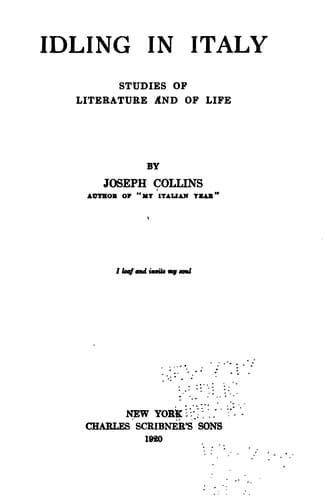
Idling in Italy: Studies of literature and of lifeCollins, Joseph
History
Idling in Italy: Studies of literature and of life
Collins, Joseph
Italian literature -- History and criticism
He acided his system, as the Italians say, with hatred and envy of his
fellow man who had achieved fame or who was upon the road to it. It is
difficult to rid one's mind of the thought that the motive that prompted
him to literary work was that he might show how contemptibly inadequate
the masters were or had been, all of them save Handel and G. Bellini.
Samuel Butler took himself with great solemnity. He believed what he
wanted to believe and he believed he knew about many things far better
than experts and empiricists. When they did not agree with him he took
great umbrage and wrote disagreeable letters to them or made disparaging
references to them in his notes. "He never could form an opinion on a
subject until he had established his volatile thoughts and caged them in
a note. This enabled him to make up his mind." Thus he made up his mind,
aided by Miss Savage, that "The Odyssey" was written by a female, or, to
use his felicitous expression, "any woman save Mrs. Barrett Browning."
Samuel Butler's most deforming characteristic was lack of reverence. He
was endowed with an orderly mind. It was his passion and pastime to
train and develop it. He never let anything stand in the way of
accomplishing that purpose. His greatest literary gift was his capacity
for presenting evidence. His chief weakness was his incapacity to gather
evidence. He assumed certain things and then proceeded to prove to the
reader that they were facts. This is a procedure that has never had
favor in the courts or in the laboratories. Neither has it been accepted
as a legitimate procedure in what might be called constructive
literature, critical or creative. The only place where it has ever been
received with favor is the pulpit, and Samuel Butler was the true son of
the cloth which he did so much to deride and from which he believed he
had divested himself.
We should never have known what a pathetic figure he was if Mr. Jones
had not seen fit in his affection and his obsession to reveal him to us.
We can forgive Mr. Jones for this, however, because of his belief that
Samuel Butler is immortal. Would that we could also forgive him for
publishing a portrait of Mr. Butler standing before the hearth in the
sitting-room of his home--in his shirt-sleeves! We could not have been
more shocked had we found that he wore garters around his arms to
regulate the length of his shirt-sleeves. England indeed is changed.
This life of Butler gives the lie to Britishers' reputation for
stolidity and formality.
CHAPTER X
SAINTS AND SINNERS
Public-domain text, read in full here on John Shaqi.
Reviews
Reviews
No reviews yet
Be the first to share your thoughts on this work.
Elsewhere in the archive
Join the Discussion
Join the discussion
Sign in to leave a comment or review.
Sign InorCreate an account