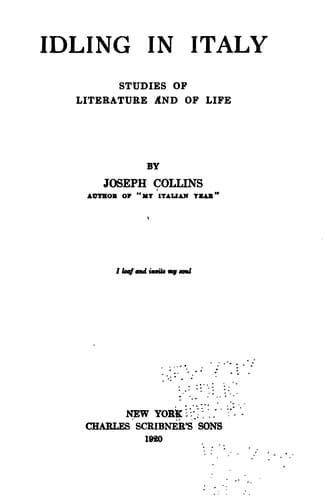
Idling in Italy: Studies of literature and of lifeCollins, Joseph
History
Idling in Italy: Studies of literature and of life
Collins, Joseph
Italian literature -- History and criticism
Mr. Jones and Alfred, clerk, valet, and general attendant, "a live young
thing about the place, and a cheerful addition to 15 Clifford's Inn,"
became very intimate with Butler. Mr. Jones had been a barrister, but
had abandoned the law and was under a modest retainer of two hundred a
year from Butler to give him Boswellian service. They found Butler
companionable, and there are such indications as letters from casual
acquaintances, particularly in Italy, to show that he was agreeable and
sympathetic to some persons.
Aside from these there is very little in these two massive volumes to
testify to the kindness, gentleness, simpleness, and humility of Samuel
Butler. Apparently he disliked every one with whom he had to do or with
whom he came in contact, save Mr. Pauli, Mr. Faesch, Lord Beaconsfield,
and Richard Garnett. Still he was pleased with Mr. Garnett's
discomfiture on hearing his lecture on "The Humor of Homer." Searching
Mr. Jones's plethoric volumes carefully, it is difficult to find kind or
appreciative words for contemporary or forebear.
"How many years was it before I learned to dislike Thackeray or Tennyson
as much as I do now?" "Middlemarch is a long-winded piece of studied
brag." "What a wretch Carlyle must be to run Goethe as he has done!" "We
talked about Charlotte Brontë; Butler did not like her." "I do not like
Mr. W. J. Stillman at all." "I do not remember that Edwin Lear told us
anything particularly amusing." "All I remember about John Morley is
that I disliked and distrusted him." "I dislike Rossetti's face and his
manner and his work, and I hate his poetry and his friends." "No, I do
not like Lamb; you see Canon Anger writes about him, and Canon Anger
goes to tea with my sisters." "Blake was no good because he learned
Italian at over sixty in order to read Dante, and we know Dante was no
good because he was so fond of Virgil, and Virgil was no good because
Tennyson ran him, and as for Tennyson, well, Tennyson goes without
saying." "I said I was glad Stanley was dead." "I never read a line of
Marcus Aurelius that left me wiser than I was before." Speaking of
Maeterlinck, who was then coming to his estate, "Now a true genius
cannot so soon be recognized. If a man of thirty-five can get such
admiration he is probably a very good man, but he is not one of those
who will redeem Israel." Though Butler was fascinated by G. Bellini, he
surely had heard of Raphael.
Darwin, Wallace, Ray Lankester, most of the scientists of his time who
did not fully agree with him; novelists, philosophers, artists,
poets--all excited his disapproval. When he was fifty-three he made a
note to remind himself to call Tennyson the Darwin of poetry and Darwin
the Tennyson of science. Thus would he empty the vials of his wrath and
contempt.
Public-domain text, read in full here on John Shaqi.
Reviews
Reviews
No reviews yet
Be the first to share your thoughts on this work.
Elsewhere in the archive
Join the Discussion
Join the discussion
Sign in to leave a comment or review.
Sign InorCreate an account