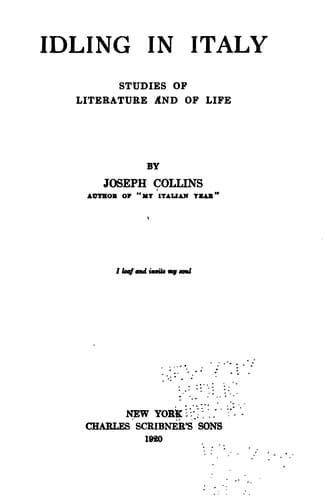
Idling in Italy: Studies of literature and of lifeCollins, Joseph
History
Idling in Italy: Studies of literature and of life
Collins, Joseph
Italian literature -- History and criticism
We get accustomed to and become tolerant of everything save pain. Even
in such upheaval as the World War it was beyond belief how little the
mechanism of daily life was disjointed. Fifteen millions of men and more
were engaged in a life-and-death struggle, and yet the ordinary events
of daily life were very little disturbed. People seemed to have time for
work, for play, for relaxation, for contemplation. I was always reminded
of this by reading the papers and observing people in theatres,
concert-halls, stadia, churches, restaurants, and public places
generally. I realize full well that one cannot sit still and nurse
either his griefs or his hopes; that man is so constituted that he must
display activity in some form. But I never fully realized that man is
chronically happy. And yet it must be so, for how otherwise could he
come out from prisons rotund and well-nourished, or from dark filthy
tenements with a smile on his face? How else could we be so
pleasure-seeking and pleasure-displaying as we were in those agonal days
of the war?
The war put many things out of joint, but it did not divorce man from
felicity save in individual instances or for short periods of time. The
thing that the war dislocated most was further tolerance of the
paradoxes of the Christian religion, the irreconcilability between
preached and practised Christianity. Every one admits that the
fundamental principles of Christianity are perfect and beautiful--that
is, they are as perfect and as beautiful as the finite mind can grasp.
But nothing can be more imperfect and uglier than the way in which the
professional pietist practises it. There isn't a tenet, as formulated by
its Founder, or such perfect disciples as St. Francis of Assisi, to
which the professing or professional Christian conforms even
approximately; and because his fellow man, prostituting it in some
similar way to conform with his personal bias, does not agree with him,
he proceeds to point the finger of scorn at him and to hail him as
infidel and unbeliever.
Public-domain text, read in full here on John Shaqi.
Reviews
Reviews
No reviews yet
Be the first to share your thoughts on this work.
Elsewhere in the archive
Join the Discussion
Join the discussion
Sign in to leave a comment or review.
Sign InorCreate an account