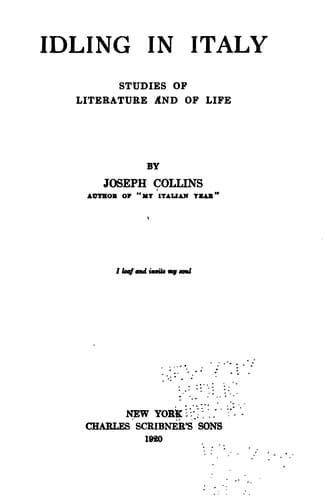
Idling in Italy: Studies of literature and of lifeCollins, Joseph
History
Idling in Italy: Studies of literature and of life
Collins, Joseph
Italian literature -- History and criticism
I have no intention of prophesying whether the church will weather the
storm in which it is now floundering or not. I think very likely it
will. One reason for so thinking is that it has weathered all previous
storms; one of them five hundred years ago was of severity that will
never be forgotten. Since then education and enlightenment have lifted
man from the supine obedience and resignation of the domestic animal,
and he has demanded, and in a measure obtained, his worldly rights. This
encourages me to believe that he may soon demand his spiritual rights:
liberation from the tyranny imposed upon his mind by the Junkers of the
church, freedom to look upon God as the fountainhead of wisdom, mercy,
and love who mediates succor to the poor, the mourning, and the meek
more willingly than to the rich, the joyous, and the arrogant; liberty
to live according to the mandates of Christ and to die in confidence
that his pledges will be redeemed. Another reason is that man must have
a religion. Individual man can live without it, but collective man
cannot, and there is not the slightest sign of the second coming of
Christ. Religion was never so openly repudiated as during the Great War,
and it never wielded as little influence on the determinations of man's
conduct as it does to-day. Those who convince themselves otherwise make
themselves immune to the teachings of experience.
The paucity of men who have the capacity for constructive statesmanship
is pitiable, but how trifling is such a capacity compared with that
required to formulate the tenets of a livable new religion! The
practices of the church to-day are not those of the thirteenth,
fourteenth and fifteenth centuries, when it was steeped in every
conceivable kind of depravity, licentiousness, simony, wealth, power,
arrogance, avarice, and flattery; when it betrayed its mission to
protect the weak; when it fornicated with the princes of the world; when
it crucified Jesus in the name of egoism. But in what way has it
espoused the sacred cause of the lowly, the best-beloved of Him who died
that eternal happiness might be vouchsafed us? If Christ's vicar could
remain silent without being called to account as was the case a few
years ago when we were offering our fathers on the sacrificial altar for
the liberation from slavery of God's ebony image, it is not likely that
he will be called on to explain a similar silence during the Great War.
I do not profess to say, not even to know, the attitude of the hierarchy
which governed the Roman Catholic church toward the war. If it was
Germanophile or Austrophile, it was more wicked than the harlot of
Babylon. I should say the same had it been Anglophile or Francophile.
The man who can believe that the temporal head of the church is the
infallible spiritual guide of her adherents cannot believe that it
should take sides against any of her own people. "The house divided
against itself must fall." What I should like from the church is a
Public-domain text, read in full here on John Shaqi.
Reviews
Reviews
No reviews yet
Be the first to share your thoughts on this work.
Elsewhere in the archive
Join the Discussion
Join the discussion
Sign in to leave a comment or review.
Sign InorCreate an account