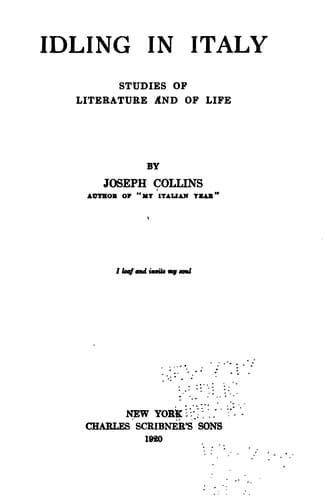
Idling in Italy: Studies of literature and of lifeCollins, Joseph
History
Idling in Italy: Studies of literature and of life
Collins, Joseph
Italian literature -- History and criticism
It occurred to me that perhaps these were the men who sat down on the
sides of the road and in the fields before that great disaster in the
Friuli and were resigned to being taken captive, and that the
resignation which they then displayed had been stamped on them gradually
day after day since then, until now it had become indelible. Life had
had no joy or poetry for them. Neither the present nor the future
had been tinctured with pleasure nor flavored with hope, and since
that day they had been silently awaiting that which now seemed
imminent--translation.
I could not but contrast the event of the morning with that of the
evening. Probably every one of these boys and men had been brought up in
the faith which the Holy Father claims is the only true one. They had
been taught that God is Justice. They had been imbued since earliest
infancy with the belief that, next to loyalty to God, their most sacred
duty was to their country. In their own way they had done their best for
both, and this was their reward. Their expressions of despair, their
manifestations of hopelessness, their silent portrayal of their
abandonment needed no explanation. The saint in the Vatican was having
his reward on earth, and the sinners in Forte Tiburtino looked for
theirs only in heaven.
"Ahi giustizia di Dio! tante chi stipa
Nuove travaglie e pene, quanto io viddi?
E perchè nostra colpa si ne scipa?"
"Ah, Justice Divine! who shall tell in few the
Many fresh pains and travails that I saw?
And why does guilt of ours thus waste us?"
CHAPTER XI
WOMAN'S CAUSE IS MAN'S: THEY RISE OR SINK TOGETHER ...
"But I would have you know that the head of every man is Christ:
and the head of the woman is the man; and the head of Christ is God
... but the woman is the glory of the man. For the man is not of
the woman but the woman of the man. Neither was the man created for
the woman; but the woman for the man."
Woman's position in the world, socially, politically, and economically
was profoundly altered by the Great War. Every contact with the affairs
of the world, save uxorially, was changed and I believe that one of the
aftermaths of the war will be further to change that relationship, to
extend her liberty, to enhance her privileges until every semblance of
the cage that has confined her since time immemorial is destroyed.
Public-domain text, read in full here on John Shaqi.
Reviews
Reviews
No reviews yet
Be the first to share your thoughts on this work.
Elsewhere in the archive
Join the Discussion
Join the discussion
Sign in to leave a comment or review.
Sign InorCreate an account