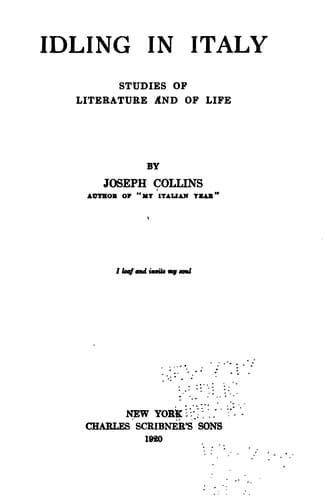
Idling in Italy: Studies of literature and of lifeCollins, Joseph
History
Idling in Italy: Studies of literature and of life
Collins, Joseph
Italian literature -- History and criticism
Eye-witnesses of the political and social emancipation of women do not
realize how extensively concerned with it the historian of the future
will be. Even less do they realize how directly certain social and
economic changes of the beginning of the twentieth century will be
traced to the entrance of women into the political arena. The individual
who would attempt to forecast the eventual effects of national
prohibition upon a people would have no respect whatsoever for his
reputation as a prophet. I assume there is little doubt that women
initiated and in large measure accomplished that legislation. Small
wonder they did. They had to bear the brunt and the pernicious effects
of alcohol consumption. Man drank it, but women paid; paid in privation,
in suffering, in disease, in ignominy--they and their children. There
are many habits, conventions, laws that deal with women differently than
they do with men. We may confidently anticipate that woman in full
possession of political privileges will soon turn her attention to
legislation whose purpose will be to change this, to effect a like
relationship of all human beings but especially of men and women.
The most ardent and pious Christian must admit that the practice of its
principles is inimical to woman's welfare or woman's full development,
using the terms welfare and development in the conventional sense of
to-day. There are undoubtedly many intelligent, honest, serious women
who subscribe to St. Paul's teachings of woman's duties and privileges
and who take no umbrage at his pronouncements. These were in a word that
she should be man's aid, his servant, and his ornament; that she should
minister unto his corporeal needs, and that she should be the instrument
through which God permitted man to reproduce his image and perpetuate
mankind. The Christian religion came gradually to be considered
figurative in its practicability, an ethical system strict conformation
to which would cause the individual to be looked upon as a victim of
mental aberration, but ideally quite perfect. With this conception the
restrictions put upon woman's activity gradually began to disappear, and
those that remained, such as, for instance, being obliged to cover her
head in church, were not only willingly accepted but were considered a
prerogative in so far as they facilitated personal adornment and thus
contributed to the realization of a fundamental, inherent ambition--to
be attractive.
Public-domain text, read in full here on John Shaqi.
Reviews
Reviews
No reviews yet
Be the first to share your thoughts on this work.
Elsewhere in the archive
Join the Discussion
Join the discussion
Sign in to leave a comment or review.
Sign InorCreate an account