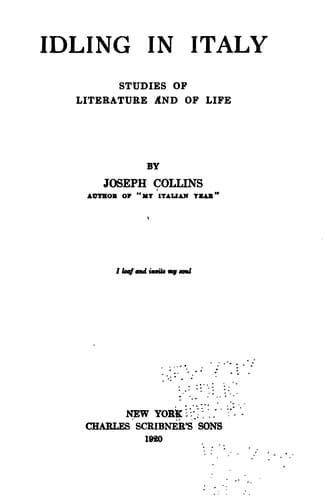
Idling in Italy: Studies of literature and of lifeCollins, Joseph
History
Idling in Italy: Studies of literature and of life
Collins, Joseph
Italian literature -- History and criticism
No one was so fatuous as to believe in 1914 that the Central Powers,
after having devoted a quarter of a century to the most assiduous
training and preparation for the war that they thrust upon the civilized
world, would not jeopardize the liberty of the world. The Allied nations
had been content apparently to risk their fate without such preparation
merely because they had right on their side. They made many mistakes and
some of them were so flagrant and enormous as nearly to have cost them
their existence. Women likewise have right on their side in the struggle
which they have waged against the mandates of Christianity and the
usurpation of man. But right alone is not sufficient in such a contest.
They must combine might with it and might these days spells
organization. Without it nothing worth while can be accomplished. I
venture to prophesy that the striking legislation of our country of the
next generation will be accomplished largely by the influence of
organized women. This war has given them opportunity to display their
might and examples of what organization can accomplish. Unless I
misconstrue all signs, they will never again be deprived of the
privileges which they have at the present day. On the contrary, such
privileges will become larger and more comprehensive until they are upon
an absolute equality in every walk of life with man.
In the world of politics, society, economics, education, and religion
the question of rights of woman may not be given the constructive
attention to which it is entitled. In our country it is possible that
women are sufficiently organized to present their claims and insist upon
their being heard, and not only demand their rights, which are liberty
and equality, but they will get them. In England I am not so confident
of the result. In France and Italy I am still less confident; in fact,
their cause in these countries as things are at present seems to me
almost a hopeless struggle. The only thing that consoles me is history.
When one recalls that all that which we now speak of as democracy flowed
from one master mind in Cromwell's little army; that the Laocoön hold
which the church had upon the people in the Middle Ages was broken by
Luther and a few similar masters whose spirits successfully carried the
idea of liberty; that all that which is now spoken of as industrial
ascendancy flowed from the activities of one or two supermen in the mill
districts of northern England only three or four generations ago; then
one is lifted above his depression. Liberty and tolerance have taken on
a new significance. This is not due entirely to the war. The war minted
the meanings, but the gold was ready for the stamp. Liberty has come to
mean that woman and man are not only equal before God but that they are
equal before man. And, now that this admission has been wrung from
unwilling man and imposed upon governments one after the other, what
kind of a life do we wish? What are our visions? What are our sane and
Public-domain text, read in full here on John Shaqi.
Reviews
Reviews
No reviews yet
Be the first to share your thoughts on this work.
Elsewhere in the archive
Join the Discussion
Join the discussion
Sign in to leave a comment or review.
Sign InorCreate an account