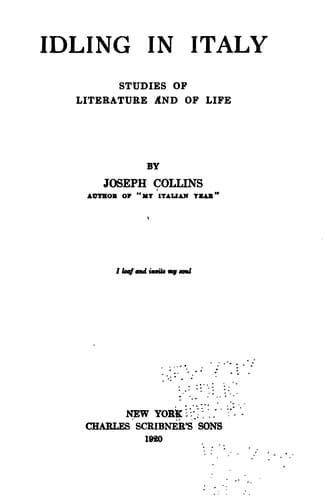
Idling in Italy: Studies of literature and of lifeCollins, Joseph
History
Idling in Italy: Studies of literature and of life
Collins, Joseph
Italian literature -- History and criticism
legitimate aspirations? Are we willing to yield supinely to the tyranny
of state or of money? Are we content further to tolerate the infirmities
and impotency of present-day education? Shall we continue to close our
eyes to the hypocrisies of the church? Shall we be willing to submit to
the restrictions that are put upon us by law and covenant concerning
marriage and its entailments? Shall we bow down to autocratic
governments whose rulers claim, and apparently have their claims
allowed, to have divine guidance? Shall we be content with the
concentration of property or of private capitalistic enterprise? Shall
we be callous enough to see countless thousands of God's own, the poor,
deprived of the advantages of food and clothing, education and the gifts
of hygiene--in brief, of everything that makes life worth living? I
firmly believe that the rank and file of educated, thinking,
serious-minded persons who are not immediately concerned with the
possession or administration of any of these, will not tolerate them,
and in so expressing my belief I do not feel that I label myself
socialist. I feel that I enroll myself in the legion marching forward
under the banner of liberty and the belief that enlightenment is
followed by progress as unerringly as night is followed by day.
These things may be brought about by revolution, just as democracy was
brought about in France after the teachings of Voltaire, Rousseau, and
the French encyclopædists had blazed the way and the aftermath of the
American Revolution had reached that country; but I am firmly convinced
that one of the things that the World War will accomplish is that this
social reformation and reconstruction will be brought about without
violence and without revolution. Once a satisfactory integration of a
large number of individual lives is brought about, then integration of
the community and of the state is bound to follow. No one is so fatuous
or so blind as to hope that integration of individual life can come to
him whose creative impulses in any field are hampered or stultified, but
when these creative impulses, whatever they be, are encouraged,
nurtured, developed, facilitated, then the genus homo will reach its
full estate and we may confidently look forward to community and state
integration upon which lasting reform can be carried out socially and
politically. There is not the slightest advantage to be gained by what
is called political and economic reform unless at the same time there is
a reformation of the creative forces of life--education, sex relations,
and religion.
Any scheme of life that concerns itself only with life is bound to be a
failure. Man is so constituted that he must have a philosophy from which
he can form a creed that facilitates his craving for immortality. It is
this belief in immortality, as fundamental a demand as life itself,
which is the final conditioning impulse of all that is best in man and
which gives him an inexhaustible strength and a lasting peace.
Public-domain text, read in full here on John Shaqi.
Reviews
Reviews
No reviews yet
Be the first to share your thoughts on this work.
Elsewhere in the archive
Join the Discussion
Join the discussion
Sign in to leave a comment or review.
Sign InorCreate an account