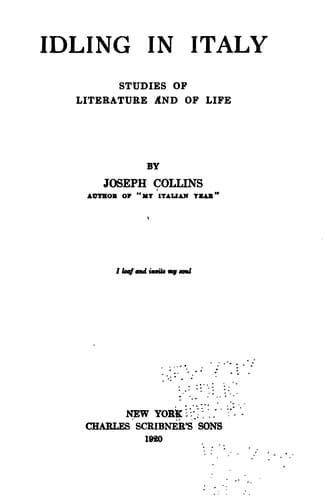
Idling in Italy: Studies of literature and of lifeCollins, Joseph
History
Idling in Italy: Studies of literature and of life
Collins, Joseph
Italian literature -- History and criticism
How any intelligent person can believe that the teachings of Christ as
practised to-day, and I emphasize the word "practised," furnish such a
philosophy or a system of ethics, transcends my understanding. The chief
branch of the Christian religion stands for dogma to-day just as firmly
as it did before the Renaissance, and it pretends the humility of Christ
while maintaining the imperiousness of Cæsar. There is scarcely a
minister of the Protestant church who is not selling his birthright for
a mess of pottage by not daring to get up in his pulpit and tell his
flock that they must live up to the basic principles of Christ's
teachings. These ministers are just as cognizant as I am that their
branch of the Christian church has lost its hold upon the people except
in so far as its alleged teachings are reconcilable with their
pleasurable conduct in private and in public affairs. I do not mean to
say that there are not many wholly sincere and devout believers in these
churches who feel the inspiration of the teachings of Christ. But
because they are paid workers in the vineyard of the Lord they dare not
jeopardize their existence and take no heed for the morrow, and they
dare not insist that those to whom they minister should conform their
conduct to Christ's commandments, because it would hazard their very
existence and provoke the starvation of their children.
Do the meek inherit the earth? Have they inherited it? Does any one
rejoice and be exceeding glad when men revile him and persecute him and
say all manner of evil against him falsely? Is there any clergyman
to-day who is teaching and insisting that if any one shall break any one
of these least commandments and shall teach men to do so he shall be
called the least in the Kingdom of Heaven? Suppose we grant that the
Sermon on the Mount is not to be taken literally, but symbolically, of
what are these mandates symbolical? "If thy right eye offend thee, pluck
it out and cast it from thee. If thy right hand offend thee, cut it off
and cast it from thee." Why does one not give the same heed to these
commands as he does to "Thou shalt not kill; thou shall not commit
adultery"? The reason is that he who kills or commits adultery is liable
to be punished by the law, and he is deterred by the fear of such
punishment or of the social ostracism to which he would be subject.
Christ referred to the fact that "It hath been said that whosoever shall
put away his wife, let him give her a writing of divorcement, but I say
unto you that whosoever shall put away his wife, save for the cause of
fornication, causeth her to commit adultery." But the present-day
mandates of Christianity are in no way in keeping with this.
Public-domain text, read in full here on John Shaqi.
Reviews
Reviews
No reviews yet
Be the first to share your thoughts on this work.
Elsewhere in the archive
Join the Discussion
Join the discussion
Sign in to leave a comment or review.
Sign InorCreate an account