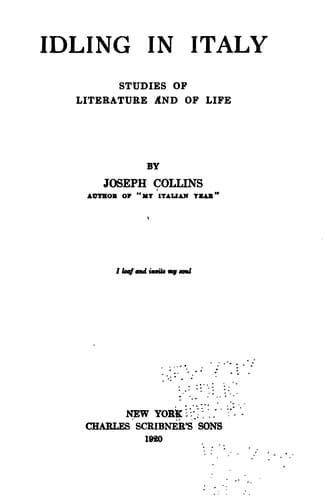
Idling in Italy: Studies of literature and of lifeCollins, Joseph
History
Idling in Italy: Studies of literature and of life
Collins, Joseph
Italian literature -- History and criticism
hundred thousand American soldiers would not only be a great moral
force, but would impart fresh vigor to the national resistance.
No one denied the truth of these statements, but cogitating on them one
is led to certain reflections, and they are: With an army of four
millions of men, why is it they were able to put only a million and a
half on the front? I understand that men were needed for munition
factories, for the essential industries that provide for war
consumption, and for the maintenance of the civil population; that
fields must be tilled, mines must be worked, water power must be
guarded, and railways must be manned. These things have to be done in
every country, but soldiers do not do them. Other countries have
militarized workmen, but they do not count them when they are
enumerating the man strength of their army. In reality Italy had called
to the colors all her healthy men between eighteen and forty-five in
order that she might more easily manage them, govern them, discipline
them.
The outsider who sees Italy through the veil of her statesmen's oratory
and polemics knows her only pleasantly masked. One is led to think
sometimes that they are more concerned with the appearance than the
substance. It often looks as if they were banking too much upon her
great and glorious past, and not looking to the furthering of conditions
that make for the happiness and efficiency of their people. The
conditions produced by the war have reminded the politicians in control
that the people love their government in proportion to the benefits they
derive from it, and I fancy it has at times felt that the people were
not giving it that strong support which is rooted in love and
consideration. "Four-fifths of the Italians have always lived on the war
footing," said Prime Minister Orlando in one of his speeches to
Parliament. He meant to convey that the Italians, being accustomed to
hardships and sacrifices, could stand war better than others. He claimed
to see in this a source of strength. Yet he must have known that the
soldiers lying down by the roadside in the days of Caporetto, awaiting
with Mohammedan indifference the coming of the Austrians, were replying
to the officers who were urging them to retreat to some place of
reorganization: "We have always lived on polenta, and we shall always
have it, and it will always taste the same even if the Austrians win."
Though not responsible for the sins of the past, it seems incredible
that the authorities were not aware of this wide-spread feeling among
the people.
Public-domain text, read in full here on John Shaqi.
Reviews
Reviews
No reviews yet
Be the first to share your thoughts on this work.
Elsewhere in the archive
Join the Discussion
Join the discussion
Sign in to leave a comment or review.
Sign InorCreate an account