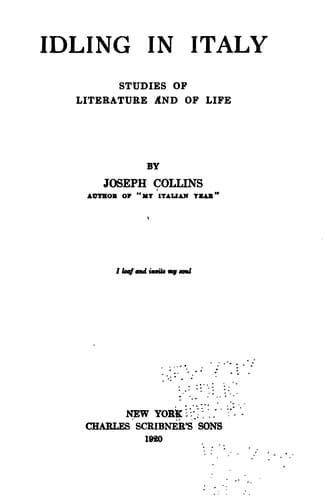
Idling in Italy: Studies of literature and of lifeCollins, Joseph
History
Idling in Italy: Studies of literature and of life
Collins, Joseph
Italian literature -- History and criticism
It is in the hour of great trial that our conscience shows us, as in a
mirror, all our past shortcomings, and it admonishes us that we reap
what we have sown. Reviewing the past, the Italian Government must have
known that it could not have the unswerving loyalty of a people who for
fifty years had been fed on promises, big words, and magniloquent
speeches covering illiterateness, oppressive taxation, obstacles to
activity, and necessity of emigration. It is not with words alone that
one gives happiness to a nation and receives love and support.
Emigration and Bolshevism are the two symptoms of the disease that
threatens the nation. Nearly a million Italians emigrated in 1913, and
socialism has a firmer footing in Italy than in any other country.
Surely these facts have far-reaching significance. The conclusion is
that there can be little doubt that men had to be called to the colors
so as to manage them better with martial discipline. Possibly it was a
wise measure and a necessary prologue to the rigid censorship and to
Sacchi's decree, which was a kind of _lettre de cachet_.
I have often asked myself, What is the Italian's most dominant
characteristic? What is his most conspicuous idiosyncrasy? One day I
answer it in one way, another in another. But on mature reflection I
think it is that he believes what he wants to believe and that he does
not trust any one implicitly. He trusts his own fellow citizen least of
all. He says he trusts him, but when he puts him in a position of trust
he puts somebody in to watch him and to report on him. The Italian has
not that confidence in his fellow human beings that a normal man has in
his honest wife, that a normal mother has in her dutiful child, that a
normal lover has in his trusted _innamorata_. I am so prejudiced in the
Italian's favor that I must defend even his infirmities. For centuries
Italy was divided and weak, and countless times she has been the tool of
the ambitious, the insatiate, and the predatory. She has been used over
and over by more powerful nations as tongs to get their chestnuts out of
the fire. For every favor she has received she has had to pay dearly,
and she has learned by sad experience that promises are usually made of
fragile material. Leaving out the treatment she received from France and
England in the nineteenth century, more particularly during the years
when she was big with nationality and unity, and during the period when
she gave birth to these beloved terms, the treatment she received from
these nations in 1911 and 1912, while she was waging the Libyan War,
still rankles in her bosom. Despite Salisbury's promises and his parable
of the stag, they recall England's disparagement of her initiative and
of her conduct of her righteous War. They recall the sinister frenzy
that France displayed when they took the S. S. _Carthage_ into one of
their ports because they believed she was carrying aeroplanes to the
Turks, and the S. S.
Public-domain text, read in full here on John Shaqi.
Reviews
Reviews
No reviews yet
Be the first to share your thoughts on this work.
Elsewhere in the archive
Join the Discussion
Join the discussion
Sign in to leave a comment or review.
Sign InorCreate an account