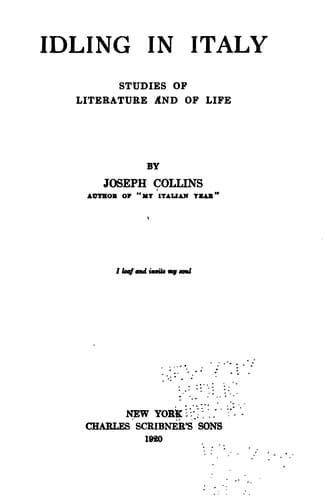
Idling in Italy: Studies of literature and of lifeCollins, Joseph
History
Idling in Italy: Studies of literature and of life
Collins, Joseph
Italian literature -- History and criticism
In April, 1918, there was a congress of Czecho-Slovaks in Rome, which
was warmly received by the Italian people and by some representatives of
the Italian Government. This congress formulated the principles upon
which it was waging war against Austria-Hungary. It set forth in
language that even a child could understand its ideas of nationality. It
put before the democratic nations of the world the ideas that they
represented and proposed to represent. Their claims received the
approbation of the prime minister of Italy, but for some inexplicable
reason the stamp of approval of Italy's minister of foreign affairs, the
only one who was in a position to represent the government
authoritatively, was withheld from them. It was necessary, apparently,
to bring the country to the brink of dissolution of its government by a
public agitation of the question initiated by the _Corriere della Sera_
before Sonnino's official approval of their aims could be secured.
Despite the fact that France, England, the United States, Japan had in
turn accorded to the Czecho-Slovaks the right of nationality, and
despite the fact that it was well known that that organization called
into being by Italy's noble, loyal sons known as the Fascio was warmly
and industriously championing the cause of these oppressed people, yet
the governmental hand had to be forced before she would put it on the
table and play her cards face upward. When the _Corriere della Sera_ was
able to throw off the manacles of the censorship and bring the subject
of discussion into the public arena, the influential journals that
represent the standpatters in the government, such as the _Giornale
d'Italia_, the _Epoca_, and even the _Messaggero_, denied that there was
any dissension or shadow of dissension between the prime minister and
the minister of foreign affairs, and they continued to deny it in the
most determined and deliberate way up until the very last moment.
Sonnino's champions maintained that the position he took was necessary
that Austria-Hungary's intrigues be rooted up and killed. The fear was
expressed that the new policy favorable to the Jugoslavs might
circumvent the stipulations of the Treaty of London, which were
favorable to Italy, and sacrifice them to the exaggerated claims of the
Jugoslav ideas of nationality.
Public-domain text, read in full here on John Shaqi.
Reviews
Reviews
No reviews yet
Be the first to share your thoughts on this work.
Elsewhere in the archive
Join the Discussion
Join the discussion
Sign in to leave a comment or review.
Sign InorCreate an account