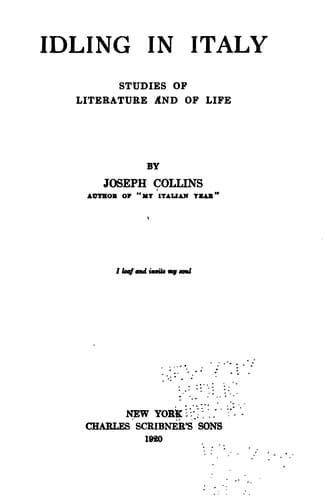
Idling in Italy: Studies of literature and of lifeCollins, Joseph
History
Idling in Italy: Studies of literature and of life
Collins, Joseph
Italian literature -- History and criticism
_Manouba_ because she had Turkish passengers
camouflaged as doctors and nurses. She recalls also that when the Hague
Tribunal practically decided in her favor, neither France nor England
displayed the slightest graciousness.
Despite these stabs of yesterday, Italy must purge herself of distrust,
which is the ferment and leaven of weakness. She must make good her
alleged trust of France, her professed confidence in England, her hail
of the United States as her deliverer. It is difficult for me to believe
that often she has not had one language on her lips and another in her
heart. The time has come when she must make the words of her heart and
her tongue one. The moment has arrived when she must put her cards upon
the table and say: "That is my hand and I play the cards face upward."
If she can be made to realize it, Italy is big with the prospect of a
glorious future and her delivery will not be long delayed.
Nothing impressed me so much in Italy during the momentous last months
of the war as her ideas of nationality, the ideas that found
dissemination, if not birth, in the prophetic soul of Mazzini and which
began to germinate nearly a century ago. "Great ideas make peoples
great, and ideas are not great for the peoples unless they go beyond
their boundaries. A people to be great must fulfil a great and holy
mission in the world. Internal organization represents the sum of means
and forces accumulated for the performance of a preordained mission
without. National life is the instrument; international life the goal.
The prosperity, the glory, the future of a nation are in proportion to
its approximation to the assigned goal." These words were written by
Mazzini several years after his ideas had made Italy great, and during
the war they were on the tongue and in the pen of every constructive
statesman who was satisfied to live only under liberty's banner.
For fifty years or more, but particularly since that fateful day, the
20th of September, 1870, when Italian union became a reality, she had
professed the profoundest sympathy for the oppressed nations of her
hereditary and actual enemy, Austria-Hungary. Since the beginning of the
World War the proud spirits of these oppressed nations, now commonly
spoken of as the Czecho-Slovaks, had been active in devising plans that
would liberate them and their peoples from the jaws of the monster. The
whole civilized world who love liberty were in sympathy with them. No
one denies that they accomplished results that were almost miraculous.
Those who had real knowledge of what was going on in the world knew that
in a measure we owed to them the secrets of Germany's diabolic
machinations in our own country when we were on terms of amity with the
Central Powers. It was not denied that Italy's success on the Piave in
June, 1918, was in some measure at least due to the information that the
Czecho-Slovaks were able to give the Italians.
Public-domain text, read in full here on John Shaqi.
Reviews
Reviews
No reviews yet
Be the first to share your thoughts on this work.
Elsewhere in the archive
Join the Discussion
Join the discussion
Sign in to leave a comment or review.
Sign InorCreate an account