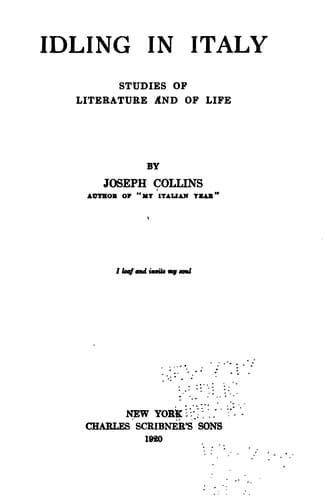
Idling in Italy: Studies of literature and of lifeCollins, Joseph
History
Idling in Italy: Studies of literature and of life
Collins, Joseph
Italian literature -- History and criticism
I gather Mr. Stone had very little schooling; that is, he did not go to
college. As a boy he went to school in the winter and worked in the
summer and during other vacations, and apparently the work that he did
most willingly was newspaper work. He became editor of the Chicago
_Daily News_ while still a very young man, and continued in that
important post for a quarter of a century. He acquired the art of going
easily and successfully to men in political life and other avenues of
constructive activity while in Chicago, Washington, and the capitals of
Europe. The thing that has made him a man of culture, however, is an
inherent desire for knowledge, which, he early realized, is the only
means that man can successfully employ to add to his stature. He is a
true Celt, emotional, sensitive, tenacious of his opinions, reliant in
his judgments, a hater of his enemies, and an admirer of his friends. If
I were asked to enumerate his most distinctive possession, after a short
intimacy with him I should say it was a quality which we speak of as
justice. When he brings a question up to the threshold of his
consciousness for solution, or a problem for decision, the first thing
that he considers is "Is it just?" After that its feasibility and
advisability are discussed.
The representative gathering of Italians which greeted him at lunch were
prejudiced in his favor. In addition to that, they were saturated with
the belief that America was the young Lochinvar who came out of the West
to deliver them from threatened bondage. I doubt very much whether any
one in America to-day realizes the feeling that Italians had for
America, and it is one of great interest. Until the advent of America
into the war Italians practically knew nothing of the United States of
America, save that it was a place to which large numbers of their
poorest and most ignorant inhabitants emigrated, and where they made
money which enabled them to return to their native land, or to maintain
their families or dependents during their exile. Of the history of
America, of the men who made that history and who are making it, of its
institutions, its traditions, its accomplishments, its potentialities
they knew practically nothing. Undoubtedly there are many who would not
accept this statement as true, but I am convinced that it is. Naturally
there are men of culture, men of studious habits, men with inclination
for historic reading who are exceptions to this blanket accusation. I
was very much amused last winter, when dining with an admiral of the
navy on duty at Spezia, by the inquiry whether I came from North America
or from South America. There are many Italians who claim to be educated
who make very little differentiation between the two continents, and I
have never yet met an Italian, unless he was a bookish man, who knew
anything about our literature. In my own profession I doubt that there
are a half-dozen men in America whose fame has reached Italy, and those
Public-domain text, read in full here on John Shaqi.
Reviews
Reviews
No reviews yet
Be the first to share your thoughts on this work.
Elsewhere in the archive
Join the Discussion
Join the discussion
Sign in to leave a comment or review.
Sign InorCreate an account