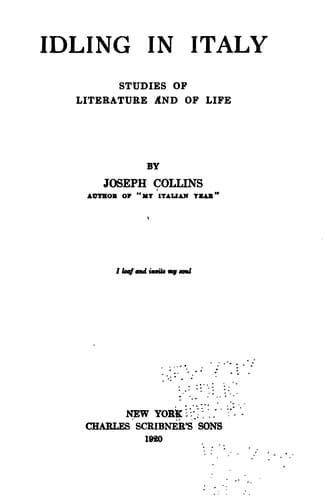
Idling in Italy: Studies of literature and of lifeCollins, Joseph
History
Idling in Italy: Studies of literature and of life
Collins, Joseph
Italian literature -- History and criticism
whose names are familiar are known because of some eponymic association.
I could cite many examples to show not only the indifference which
Italians have to the history and literature of our country but also the
absence of any desire to know about them. Then, their conceptions or
ideas of Americans are quite extraordinary. They got them from tourists
whom they saw overrunning their country en prince or en Cook, and made
up their minds that they were a type of uncivilized Croesus or of
unæsthetic barbarian. They saw the effete, the effeminate and decadent,
or the semi-invalided business man surrounded by a bevy of overdressed
females whose chief interest seemed to be their luggage and the sights;
and they saw the weary and wearisome gapers constituting the "personally
conducted." Then again, the Italian is no great traveller. He likes his
country, he is content with it, and, although he rails against his
government, he would feel that a large part of the pleasure of life was
taken from him if he were not permitted to discuss critically, and often
disparagingly, what are commonly called politics. I don't mean to say
that the Italian "fancies" himself, but neither the spirit of admiration
nor of emulation distinguishes him. He is like the Roman in miniature.
The Roman still thinks he is the last cry of God's handiwork in the
human line.
When America declared war on Germany, and particularly when she declared
war on Austria, Italians quickly got interested in America; and when
they learned that America came so generously to Italy's aid, first, in
supplying the money for the conduct of the war, and then in supplying
the material needs of her people, Italians manifested a tremendous
interest in us and in our country, and they began to look upon us as
their guide and their savior. I never heard a disparaging word of our
country or of him who was directing our ship of state until after the
Peace Conference. They looked upon Woodrow Wilson as a man inspired.
There were times during the war when they would have been very glad if
America had acquiesced more readily and more whole-heartedly in their
requests, such as in July, 1918, when they believed that it was
imperative to have large numbers of American troops in Italy. But at the
same time, when their wishes were not met and their requests not
granted, they did not sit in adverse judgment upon him who made the
decision. In fact, they believed he could not err.
Public-domain text, read in full here on John Shaqi.
Reviews
Reviews
No reviews yet
Be the first to share your thoughts on this work.
Elsewhere in the archive
Join the Discussion
Join the discussion
Sign in to leave a comment or review.
Sign InorCreate an account