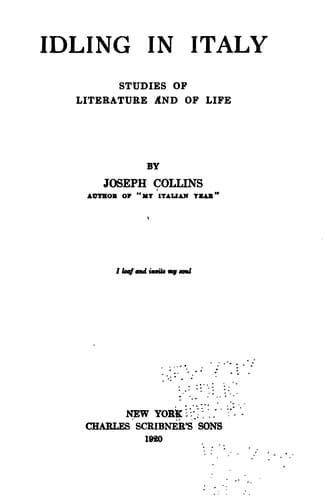
Idling in Italy: Studies of literature and of lifeCollins, Joseph
History
Idling in Italy: Studies of literature and of life
Collins, Joseph
Italian literature -- History and criticism
It is natural that they should have been concerned about the situation
that existed in the early summer of 1918. There were two millions of
American troops in Europe, with more constantly coming, and there were
only a very small number in Italy. The Italians saw themselves pitted
more or less alone against a country, Austria-Hungary, which had an army
nearly twice as large as theirs and which was more rapacious than a
hungry wolf goaded into renewed ferocity by recent defeat. They
sincerely believed that if they had received help at that time they
could have overcome their hereditary and acquired enemy promptly, and it
is likely that they could. That might have been a reason for sending
American troops to Italy, but it was not an adequate reason. The one
task in hand was to win the war, to win it expeditiously and to win it
in such a manner that would put Germany, as she was constituted and as
she had been constituted for the past twenty-five years, out of
existence; that is, to exterminate the war lords, to destroy them and
their influence. The man or men who were permitted to look at the
question from all angles were far better able to plan how this should be
done than the councillors of one nation who naturally saw the question
only from one side, that is, their own point of view.
It is likely also that the Italians constantly reminded themselves that
if they had received help from the Allies early in 1916 the war might
have been ended. I have heard many an Italian say that they were in a
position then to overcome the Austrian army had they received such help
and that with the simultaneous activity of the Russians on the eastern
front they would have carried the Allied arms into Vienna. But you do
not grind your grist more satisfactorily by regretting that the waters
that have gone over the mill were not used more efficaciously.
I have wandered far afield from the testimonial lunch to Mr. Stone, but
my reflections are apropos of the remarks which the Honorable Nitti, a
wizard with figures and a magician with men, made. Many of his
countrymen profess to distrust him and to say that Giolitti made him and
still controls him. Nothing could be more absurd. Nitti is the type of
man who is made by his endowment and by his environment. It would be
easier to think of any other public man in Italy as the tool of a
dictator, dethroned or enthroned, than it would be of Nitti. The son of
poor parents who sacrificed everything for his education, he has been
journalist, author, teacher, economist, professor, advocate, and
statesman. When he first went in the House he sat on the extreme left,
and gradually he moved up toward the centre, although he is always
inscribed in the radical party. He is unquestionably of formidable brain
and combines a will of iron with an audacity that has the appearance at
least of transcending all temerity.
Public-domain text, read in full here on John Shaqi.
Reviews
Reviews
No reviews yet
Be the first to share your thoughts on this work.
Elsewhere in the archive
Join the Discussion
Join the discussion
Sign in to leave a comment or review.
Sign InorCreate an account