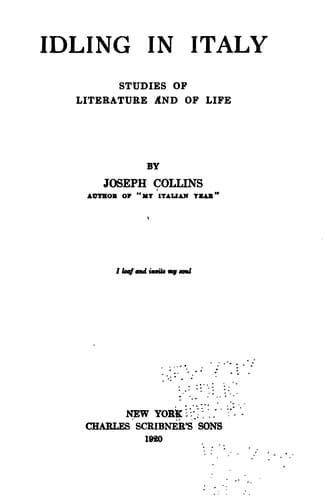
Idling in Italy: Studies of literature and of lifeCollins, Joseph
History
Idling in Italy: Studies of literature and of life
Collins, Joseph
Italian literature -- History and criticism
It takes a big man, using that word in one of its conventional senses,
to conduct a successful publicity campaign. In the first place, he has
to understand the people with whom he works, and the first successful
step in understanding them is to want to understand them. If he has
preconceived ideas not founded in reliable information or experience, if
he is biassed and hypercritical, if he doesn't know how to elicit
testimony and evaluate evidence, if he hasn't habituated himself to look
at events, heralded or transpired, from different points of view, if he
isn't animated by the spirit of service--that is, to do his work for the
good of the cause--he is doomed to failure, or at least he can be only
partially successful. Then again, he must be a man who worthily
represents his government and his people. He should know his way about.
He should be familiar with ordinary social amenities, so that he may go
easily amongst his superiors and excite their approbation, and he must
have the capacity to bear true witness while constantly keeping the
burnished side of his shield before the people he is aiming to succor
and orient. There are few ways in which one can be of more service to
his country than by making proper propaganda in an allied country. The
narrow-minded, biassed, obsessed man has the worst possible equipment
for such position.
Propaganda is the priceless privilege of the press.
CHAPTER XV
SENTIMENTALITY AND THE MALE
It is a long time now that the belief has been generally accepted that
God made man, and, contemplating his work, realized that it was a
failure for the purpose for which man was created. He then made woman.
The way in which this was accomplished is full of interest to the
artificer, but it does not concern me, whose lifelong study has been of
the finished species; nor does the object of the creation of man,
alluring as it is, tempt me to digress from the subject of his
sentimental endowment. Soon after his organism was endowed with sentient
possession, man was made aware that he had imperious desires which not
only demanded satisfaction but which insisted upon being satisfied. It
pleased the Christian church to enshroud the most vital of these
God-given desires in the mantle of sin, save when its appeasement was
done in conformity with the restrictions laid upon it by the church. It
may quite well be that such restrictions were founded in wisdom. For a
long time England maintained that it was right to restrict the franchise
to owners of property of a certain value, and for many centuries the
world accepted slavery without a thought that it was wrong. Ruskin spoke
truly when he said: "The basest thought about man is that he has no
spiritual nature, and the foolishest that he has no animal nature."
Public-domain text, read in full here on John Shaqi.
Reviews
Reviews
No reviews yet
Be the first to share your thoughts on this work.
Elsewhere in the archive
Join the Discussion
Join the discussion
Sign in to leave a comment or review.
Sign InorCreate an account