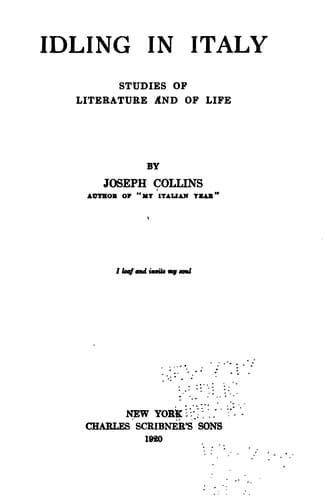
Idling in Italy: Studies of literature and of lifeCollins, Joseph
History
Idling in Italy: Studies of literature and of life
Collins, Joseph
Italian literature -- History and criticism
The facts around which these remarks are spun are first: God reproduced
his image, and, finding that the image was incomplete and useless for
the purposes for which he was created, he made him whole, as it were, by
creating the female; and second: that he endowed man and woman with
mental and emotional qualities which were to aid them in living their
lives happily for themselves, usefully for others, and acceptably to
him. The moment this endowment was made known to them the fat was in the
fire. "She tempted me and I fell" has been the subject of picture and
poem, story and sermon, excuse or extenuation, since time immemorial.
Learned tomes and ponderous volumes have set forth specifically the
difference of the sexes, more or less uselessly too, for no one needs to
be convinced that there are anatomical and physiological differences.
The obvious is never interesting; the pleasurable quest is pursuit of
the elusive, the intangible. There are differences between the sexes
that defy specific designation, for I do not admit that specificity is
given to these distinctions by saying that men differ from women
emotionally, morally, spiritually, ethically, or that they react
differently to the same stimulus under the same circumstances, or that
there are soul differences of kind and degree. We do not have to decide
whether these distinctions are inherent or acquired. We have only to
admit that they exist. The plain fact is that tradition and experience
teach us that both the male and the female of the _genus homo_ have
certain spiritual endowments, both on the emotional and the intellectual
side, which have come to be looked upon as characteristic. Courage,
valor, secrecy are universally considered to be characteristics of the
male. On the other hand, patience, sentiment, vanity, and fickleness
have become traditionally linked up with the opposite sex. Women are
often braver than men, more continent, less vain, but to admit this does
not diminish the acceptability of the general proposition. No one is
likely to contend that either sex has a monopoly of any of these
qualities, but I fancy it will readily be admitted that sentimentality,
in its most flagrant display, is a more characteristic ancilla of woman
than of man. Bulwer Lytton was a shrewd observer when he wrote: "There
is sentiment in all women and sentiment gives delicacy to thought and
tact to manner." But sentiment with men is generally acquired, an
offspring of the intellectual quality, not as with the other sex, of the
moral. A man considers it a term of reproach to be called sentimental;
on the other hand, such designation in no way detracts from a woman's
estimate of herself, nor does it derogate her in the esteem of others so
long as she confines it within certain limits and so long as it does not
condition her conduct. Many a man on reviewing his past recognizes that
his ship of celibacy foundered upon the sandy shoals called
Public-domain text, read in full here on John Shaqi.
Reviews
Reviews
No reviews yet
Be the first to share your thoughts on this work.
Elsewhere in the archive
Join the Discussion
Join the discussion
Sign in to leave a comment or review.
Sign InorCreate an account