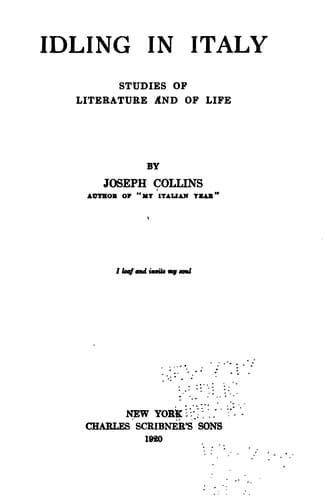
Idling in Italy: Studies of literature and of lifeCollins, Joseph
History
Idling in Italy: Studies of literature and of life
Collins, Joseph
Italian literature -- History and criticism
The average boy emerges from this period with a vision so adjusted to
his immediate environment and the world that he senses things as they
really are. He begins to get some idea of the purposes and value of
life, its obligations and its privileges, and as the result of intuition
or tuition, that happiness and usefulness, the chief aims and objects of
life, stand in direct and measurable relationship to the possession and
display of certain qualities which are commonly spoken of as virtues. As
his mind unfolds and he is able to give relativity to these qualities,
he becomes aware that sentiment in a man is not a deforming but a
meritorious possession, which, when used properly, is a great asset, but
that it is one of the qualities of his make-up that should not be
displayed to the vulgar gaze, and is a possession which he should rarely
use save to blend with other qualities to give them savor. He
appreciates that sentiment gives momentum to his designs and tone to his
accomplishments, while furnishing appropriate and fitting setting for
their display, and with discernment he is able to distinguish clearly
between sentiment and sentimentality and knows that the word sentiment
is used synonymously with feeling or conviction. Sentiment is a
composite of many of the virtues and is a subjective possession which,
when revealed in words, action, or conduct may become sentimentality,
providing the origin of these words, acts, and deeds is founded in
sentiment.
The possession of sentiment, that is, of feeling, is a most desirable
one so long as it does not warp the judgment, interfere with the
mission, or prevent a man from doing his duty. The man or woman who is
devoid of feeling is a species of monster, but the man or woman whose
plan of life is based upon sentiment and whose conduct conforms to
sentiment is mentally and morally unhealthy. As Lowell says: "Every man
feels instinctively that all the beautiful sentiments in the world weigh
less than a single lovely action." Decisions, plans of action, conduct
conditioned by or founded in sentiment can be followed safely only if
they are submitted to the acid test of reason before acceptation or
subscription. Sentiment as a possession may be compared to a ferocious
dog. He may be invaluable as a watch-dog, which adequately chained gives
you a feeling of security, and at appropriate times can be unleashed to
signal advantage, and accomplishes under guidance that which merits full
approval; but let loose at all times he is an intolerable nuisance and
may get you into one trouble after another.
Public-domain text, read in full here on John Shaqi.
Reviews
Reviews
No reviews yet
Be the first to share your thoughts on this work.
Elsewhere in the archive
Join the Discussion
Join the discussion
Sign in to leave a comment or review.
Sign InorCreate an account