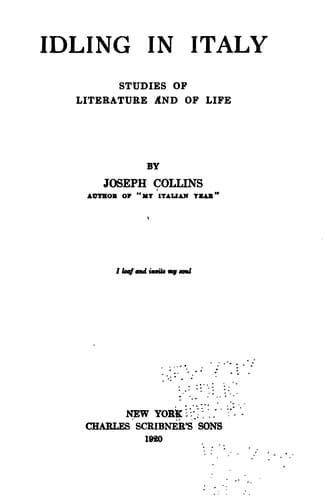
Idling in Italy: Studies of literature and of lifeCollins, Joseph
History
Idling in Italy: Studies of literature and of life
Collins, Joseph
Italian literature -- History and criticism
The sentimentalist is a person who, in decisions, judgments, plans of
action, and conduct of them, point of view in dealing with persons
individually and collectively, has his conduct so colored by sentiment
that his plan of action and ability and methods of its execution seem
illogical and incapable of being subjected to the test of reason.
Carlyle put it tersely when he said: "The barrenest of mortals is the
sentimentalist."
The agonal struggle of the Great War was not necessary to convince us
that very little is to be accomplished in the world single-handed. The
individual can give birth to the idea, the plan, or possess the
initiative which may revolutionize some phase of the activities of the
world, but to carry out the idea he must have the co-operation of many.
It is in securing such co-operation that he has a great opportunity to
make a proper use of sentiment. There is nothing that an organizer or an
administrator finds out earlier or surer than that loyalty is the cement
that keeps his organization together, and the more it sets the more firm
and invulnerable becomes his organization.
How to engender such loyalty is a problem that each person confronted
with it must solve for himself. Some do it by meriting the respect and
admiration of their coworkers and subordinates by display of such
qualities as kindliness, justice, generosity, consideration of the
welfare of their fellows, while others encompass it by the whole-hearted
and unselfish way in which they give themselves to the work. Some do it
quite impersonally and may possibly not be on terms of intimacy with any
member of their organization. This does not necessarily mean that they
hold themselves aloof from those with whom they come in contact; on the
contrary, there may exist a genial comradeship from which mutual
respect, admiration, and possibly even affection are developed. Some few
develop loyalty from personal contact on the basis of sentimentality.
They proceed upon the plan that if they cannot secure the personal
admiration and affection of those associated with them, impelling them
to do their best because of this relationship rather than for the good
of the cause, they have not been completely successful in their
accomplishment. To this end they not infrequently resort to a display of
sentimentality which is distressing to the impartial onlooker. That
great dissector of the morals and motives of men, Thackeray, said: "One
tires of a sentimentalist who is always pumping the tears from his eyes
or your own." They lavish praise upon those who have not merited it,
substituting adulation for admonition; they profess a confidence that is
not justified by results; they claim to see only virtues in every
individual who is drawn into the sacred circle of their employment or
association. Should they have suspicions that some in their circle are
not deserving of confidence or do not have the qualities from which
Public-domain text, read in full here on John Shaqi.
Reviews
Reviews
No reviews yet
Be the first to share your thoughts on this work.
Elsewhere in the archive
Join the Discussion
Join the discussion
Sign in to leave a comment or review.
Sign InorCreate an account