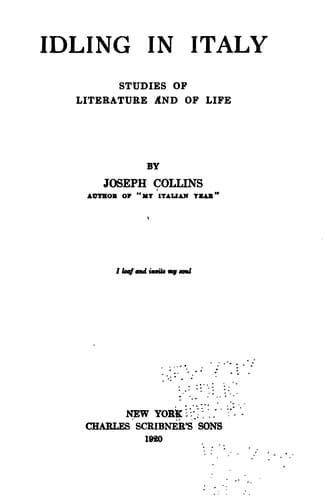
Idling in Italy: Studies of literature and of lifeCollins, Joseph
History
Idling in Italy: Studies of literature and of life
Collins, Joseph
Italian literature -- History and criticism
After crossing the Tiber I strike into the heart of the densely
populated city through a succession of narrow streets without sidewalks,
and flanked on either side with never-ending little shops, now and then
crossing a piazza which gives space and light to some massive mediæval
palace. But none of them solicits me to stop until the Palazzo Braschi
comes into view. I have seen its wondrous staircase, with its many
columns of Oriental granite, so often that I would pass it by without a
thought were it not for the brutally hideous figure of Pasquino, who
greets me from his pedestal like an old acquaintance. I realize quite
well that he has been called one of the most beautiful remains of
antique sculpture, and that the expert eye, guided by a knowledge of
Hellenic art supremity, may see charm and wondrousness in it, but I have
bid him good-morning and good-day many times, and, like some old
acquaintances, he does not get nearer my heart as I learn to know him
better. There have been innumerable conjectures as to what the figure
represents. The one most generally accepted is that it represents
Menelaus supporting the dead body of Patroclus after the vile Trojan had
stabbed him in the back while Hector was engaging his attention. You
have such a feeling of pride in Patroclus and the wonderful things that
he did with his Myrmidons that your heart goes out to him. When the
Trojan War was going badly, he was persuaded to take up the direction of
the forces against the enemy, and one cannot help feeling grateful to
Menelaus for having played the good Samaritan to him at the end. But if
this old King of Sparta had made Helen behave better when Paris came to
visit them, she might never have eloped with that hazardous youth after
he had made the memorable decision on Mount Ida, spurning power promised
by Juno, and glory and renown tendered by Minerva, in order that he
might have the fairest woman in the world for wife. But one should not
be too hard on the old king. There is no telling just how far Helen
acted on her own initiative and how far Venus was responsible for the
flight. Still, were it not for this little irregularity in the conduct
of the royal household, we would have been denied a knowledge of the
greatness of Greece and a record of its accomplishments in one of the
greatest poems, which has been a solace and a stimulation to countless
lovers of literature the past two thousand years.
Public-domain text, read in full here on John Shaqi.
Reviews
Reviews
No reviews yet
Be the first to share your thoughts on this work.
Elsewhere in the archive
Join the Discussion
Join the discussion
Sign in to leave a comment or review.
Sign InorCreate an account