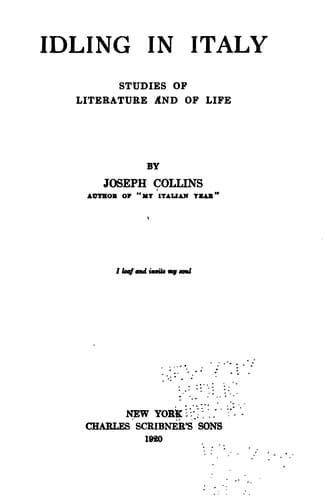
Idling in Italy: Studies of literature and of lifeCollins, Joseph
History
Idling in Italy: Studies of literature and of life
Collins, Joseph
Italian literature -- History and criticism
Though I bring no trained eye or accurate information to the discussion
of Pasquino's identity, I am convinced, since seeing the bronze statue
of a boxer which Lanciani unearthed in excavating the Baths of
Constantine in 1885, that this statue is no other than an early marble
setting forth the same subject. To me it is the effigy of a fighting
brute. Whatever his name or his profession may have been, he has become
known the world over as Pasquino, and satires and sarcasms similar to
those which he is supposed to have uttered to the amusement and
edification of the Romans in the fifteenth and sixteenth centuries have
become known as pasquinades all over the world.
Italians like to write stories concerning historic incidents and to
embellish them with a veneer of verisimilitude. They like particularly
to give them a personal note, deprecatory or laudatory. When the
Egyptian obelisk was being forced to a perpendicular position in the
Piazza of St. Peter's, the crowd had been admonished under penalty of
death to be silent. The stillness of the piazza, broken only by the
creaking of the ropes, was suddenly torn asunder by a shout of "Wet the
ropes." Thus the famous obelisk was preserved intact, and the man whose
discernment had accomplished it, instead of having his head cut off, was
allowed to furnish the palms for St. Peter's every Palm Sunday.
Incidentally he was ennobled, and since that time his reward has been
the family's chief asset. In the same way, one of the river gods of the
fountain set up in the middle of the Piazza Navona seems to be drawing a
mantle up over his head while the others, those of the Danube, the
Ganges, and the Rio della Plata, are looking straight ahead. Bernini,
who built the fountain, says that Nile was so shocked by the façade
which Borromini, a contemporary architect, added to the Church of St.
Agnes, which is immediately in front of it, that he had to veil his
face.
The story of Pasquino is that he asked questions concerning the conduct
of the reigning power, which, of course, in those days was the pope, and
made reflections which Marforio, the river god which stood between the
horse-tamers in the Piazza della Quirinale, answered. Pasquino, in
short, became the organ of public opinion, and it was not subject to the
censor, for the authors prudently kept out of sight. His most poisonous
venom and destructive wrath were directed against popes and cardinals.
If he said the things that he is alleged to have said about Alexander VI
and Innocent XI (the holy man who started the Inquisition), it is easy
to understand that one of their successors wished to throw him into the
bottom of the Tiber, the resting-place of countless priceless objects of
art for many centuries. As a matter of fact, however, the stories about
Pasquino to be found in every guide-book are, like many other stories
when run to earth, largely fiction.
Public-domain text, read in full here on John Shaqi.
Reviews
Reviews
No reviews yet
Be the first to share your thoughts on this work.
Elsewhere in the archive
Join the Discussion
Join the discussion
Sign in to leave a comment or review.
Sign InorCreate an account