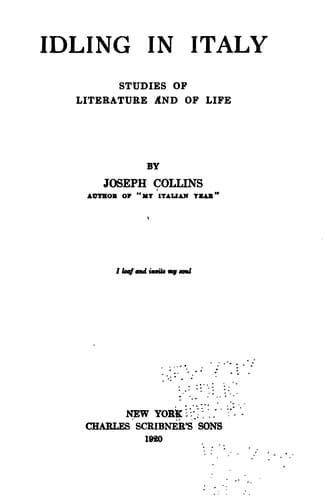
Idling in Italy: Studies of literature and of lifeCollins, Joseph
History
Idling in Italy: Studies of literature and of life
Collins, Joseph
Italian literature -- History and criticism
A few paces beyond the Palazzo Braschi I suddenly come upon one of the
most attractive and alluring piazzas in Rome, the Piazza Navona, or, as
it is sometimes called, the Circo Agonale. By its oblong form, its
seductive symmetry, its elaborate decorations--three beautiful
fountains, the central one surmounted by an Egyptian obelisk which once
stood in the Circus of Maxentius; by its boundaries, which include the
Palazzo Pamfili, the Church of S. Agnese, and the Church of S. Giacomo
of the Spaniards, and innumerable small and large houses--it succeeds in
conveying to the observer, who is susceptible to æsthetic impressions,
sensations which are as purely pleasurable as anything can possibly be.
Were it not for the distinctively Italian architecture one might easily
imagine that he was in the centre of some provincial large city of
France. It has, more than any other public square that I have ever been
in, that quality which we speak of as foreign. No two buildings are
alike, and, mean though many of them are, and especially toward the
northern end, they blend in such a way as to produce a perfect harmony
of color and architectural effect. In olden times they held races here,
and I can imagine how marvellous a sight it must have been with the
palaces and houses gayly decked with flags and drapery, rich rugs
hanging from the window-sills, on which leaned beautiful ladies, frail
and strong, attended solicitously, perhaps watchfully, by cavaliers and
admirers, and the square below filled with the pleasure-loving crowd
whose conduct betrayed nothing else save a desire to be amused and
diverted. During the summer I often sat for a half-hour on my way home
in this square, and, while watching the countless children from the
surrounding tenements in those simple indulgences which they call play,
tried to fancy some of the events that had taken place in the square and
in the palaces and churches bordering it.
It was in the Pamfili Palace, built by Innocent X in 1650 for his
predatory and dissolute sister-in-law, Olympia Malacchimi, that the
fortunes of the Pamfili family began. Here she sold bishoprics and
beneficences, and here she externalized that conduct which brought
infamy on her name. What a story an account of the intimate doings of
that family would make! Their palace in the Corso is one of the most
beautiful Renaissance residences in the world, and their villa on the
Janiculum is an approximation to a rural paradise. All that is left of
the family is a faded, sad, suggestible, middle-aged princess, whose
English appearance and manner betray a lifelong habit of emotional
suppression, and one son who is eking out his miserable days in the
mountains of Switzerland.
Public-domain text, read in full here on John Shaqi.
Reviews
Reviews
No reviews yet
Be the first to share your thoughts on this work.
Elsewhere in the archive
Join the Discussion
Join the discussion
Sign in to leave a comment or review.
Sign InorCreate an account