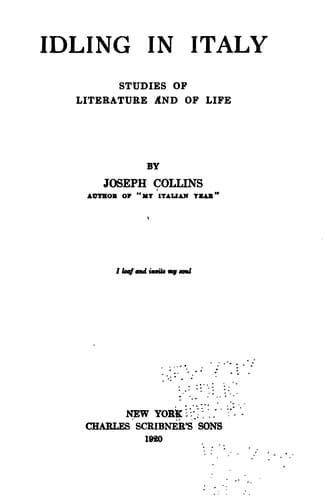
Idling in Italy: Studies of literature and of lifeCollins, Joseph
History
Idling in Italy: Studies of literature and of life
Collins, Joseph
Italian literature -- History and criticism
Thirty years ago there was published in the _Nuova Antologia_ an article
by Domenico Gnoli which sets forth the real history of Pasquino. When
Cardinal Carraffa went to live in the Braschi Palace he had the statue
set up at one of the corners, and there it has since remained. In those
days religious processions were as common as automobiles and bicycles
are to-day. The priests in them often rested at this corner, and it
became the custom to make up the statue to represent different
personages, and the man who was intrusted with this task happened to be
a professor in the adjacent university. He encouraged his boys to write
epilogues, elegies, and epigrams which they pasted or stuck on the
statue. At first these were purely literary efforts, juvenile flights to
Parnassus, but later they took on a political and social flavor, while
still later they became concerned with the doings of the Curia. These
pasquinades have been collected in book form, and some of the volumes
exist at the present time. The majority, however, have been
lost--perished in flames, destroyed as having no value, or disappeared
in other ways. Thus the statue was initiated as a news-bearer or organ
of public opinion.
Immediately across the road from the statue there was a tailor or barber
shop, and the name of the chief operator was Pasquino. It was in this
shop that the messages stuck on the statue were collected, deciphered,
and discussed, and when the witty tailor died they gave his name to the
statue and thus immortality was thrust upon him. In reality, after the
cessation of the publications, "Carmina quæ ad Pasquillum fuerunt posita
in anno," and the murder of the professor who had encouraged his
students to put forth their youthful efforts, men groaning under the
oppression of their rulers, men big with ideas of what we now call
liberty, men in whom the germs of freedom and equality had been
implanted, saw a fairly safe way of getting their sentiments before the
public, and they utilized Pasquino as a forum from which they could
radiate their ideas and their sentiments. During the entire sixteenth
century these men conveyed to the Borgias and to Julius II and Paul III
and Innocent X and Innocent XI and Pius VI an expression of their
feeling and conviction concerning their conduct, individually and
collectively. Whether these contributions had anything to do with
shaping public opinion and leading up to the great Reformation, it is
impossible to say.
Whatever Pasquino accomplished or didn't accomplish seems not to concern
him, for there he sits tranquilly upon six blocks of volcanic stone,
indifferent to the passing show and to the transpirations of the world.
Public-domain text, read in full here on John Shaqi.
Reviews
Reviews
No reviews yet
Be the first to share your thoughts on this work.
Elsewhere in the archive
Join the Discussion
Join the discussion
Sign in to leave a comment or review.
Sign InorCreate an account