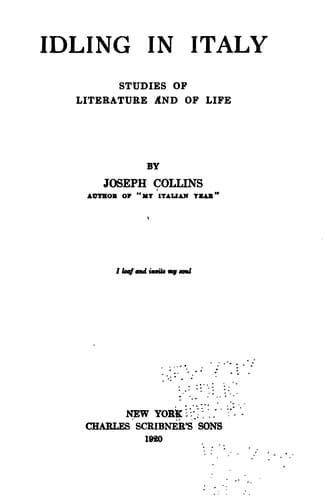
Idling in Italy: Studies of literature and of lifeCollins, Joseph
History
Idling in Italy: Studies of literature and of life
Collins, Joseph
Italian literature -- History and criticism
Guido Mazzoni, born in 1859, was, and perhaps still is, professor at the
University of Florence. He has been for many years secretary of the
Crusca and senator of the realm. His critical work is "L'Ottocento." His
poetry is of the familiar variety. "Sewing-machine" is one of them. He
is an excellent example of the culture of the Italians, but he has made
no lasting impression upon Italian letters. He is best known in this
country from Papini's gibes at him and at the Crusca. His recent
contributions, "The Lament of Achilles" and "Con Gli Alpini" ("With the
Alpini"), are of the eminently respectable, commendable, poet-laureate
variety, called forth by valorous deeds of Italy's soldier sons.
Nothing shows the flight from romanticism to realism that took place at
the end of the nineteenth century so clearly as its stage literature.
The dominating figure of that period was Giuseppe Giacosa. He was not
alone the most prolific contributor to the literature of the theatre,
but a man who early excited and kept the admiration and affection of
fellow artists. He can truthfully be called the literary mirror of that
period in Italy.
The lamp of enthusiasm was flickering when he first put secure steps
upon the literary road, but it lighted him to a great success in "Una
Partita a Scacchi" ("A Game of Chess"). Then the car of realism came
along with a rush, as if it would carry everything in its wake, and he
threw a great bouquet into the tonneau in the shape of "Surrender at
Discretion." But his ear was always to the ground, and, when he sensed
the advent of a new literary period and learned of the existence of
readers that did not know just what they wanted but thought they would
like to have the truth, the naked truth of life as depicted in fiction,
he wrote "Sad Loves." But the Veristic period did not last long, and
Giacosa took leave of it without a tear. Pascoli and D'Annunzio had not
only entered idealistic realism in the literary race, but they were
shouting in the most vociferous way for the latter especially to win.
When Giacosa became fully cognizant of the favorite colors he was quick
to make his entry with "As the Leaves" and "Il Più Forte" ("The
Stronger").
The play to which he owed his first success, "A Game of Chess," had a
remarkable career in Italy, and it still makes leading appeal to
extravagant youth and romantic maturity, who see, in the lovely Iolande
or in the dashing Fernando, prototypes who solve perplexing problems of
life with an ease and readiness that is soul-satisfying. They also see
in their experiences the smouldering or dying embers of their own
passions, whose articulate breathings cause them to glow consumingly and
pleasantly.
Its success turned the author from law, which he despised, to
literature, which he adored.
Public-domain text, read in full here on John Shaqi.
Reviews
Reviews
No reviews yet
Be the first to share your thoughts on this work.
Join the Discussion
Join the discussion
Sign in to leave a comment or review.
Sign InorCreate an account