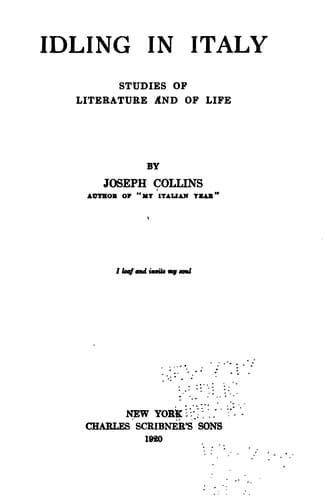
Idling in Italy: Studies of literature and of lifeCollins, Joseph
History
Idling in Italy: Studies of literature and of life
Collins, Joseph
Italian literature -- History and criticism
If he is utterly oblivious to the two last, his writings may be as
immoral or unrighteous as he wishes to make them. If the public does not
wish to read them it need not, and if it considers them injurious to
others whose mental capacity does not enable them to judge whether they
are proper or injurious they can be suppressed. If, however, the writer
is animated to production by either of the latter two motives, he must
be reconciled to having an estimate made of his work not only from the
point of view of literary criticism, but also from the point of view of
the fitness of his works for literary consumption. That is, he must be
reconciled to attempts at estimating whether or not the world would not
have been better off without his writings.
There are few writers to whom these remarks apply with greater force
than Gabriele D'Annunzio. It is generally admitted that he is the most
consummate master of Italian verse now living. Though his prose writings
show that he is not a literary craftsman of the first order, he has
understood that art rises out of our primal nature and that it is
instinctive. He has sung the praises of sensualism as they never have
been sung in modern times, and he has panoplied the preliminaries to
love's embrace with garlands made of flowers of forced blooming,
artificially perfumed and colored so that the average human being does
not recognize them as products of nature. He has preached and practised
a moral code the antithesis of Christianity, and yet no one has sought
seriously to save his soul.
In truth, D'Annunzio had tired the world of him. The people of it were
tired of him as they might have been of a radiantly beautiful woman who
had become a gorgeously decorated strumpet constantly walking up and
down in the world seeking praise and admiration. When he went to Paris
the world seemed to be satisfied that he should disappear in that
maelstrom, as it was willing that a contemporary sensuous egocentrist
should disappear when he left Reading Gaol, but D'Annunzio must enter
upon the final stage of his mission from the gods, and the Great War
gave him the opportunity.
Public-domain text, read in full here on John Shaqi.
Reviews
Reviews
No reviews yet
Be the first to share your thoughts on this work.
Join the Discussion
Join the discussion
Sign in to leave a comment or review.
Sign InorCreate an account