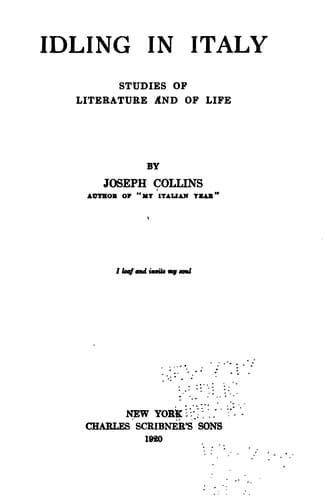
Idling in Italy: Studies of literature and of life — John Shaqi
Idling in Italy: Studies of literature and of lifeCollins, Joseph
History
Idling in Italy: Studies of literature and of life
Collins, Joseph
Italian literature -- History and criticism
There are two ways of approaching an estimate of D'Annunzio. One is to
analyze him--to set him up as a god or a monster and to dissect him and
study the elements of his complex mechanism, then put them together
patiently and laboriously as one puts together a jigsaw picture-puzzle.
It is the tempting way, but it risks injuring the sensibilities of his
admirers and the judicially minded who are so constituted that they
cannot pass judgment unless they are in possession of all the facts
concerning him and his career: what he did and the circumstances
attending the doing of them, that is, the environment in which they were
done--both that which he created and that which was thrust upon him.
Finally they want to view him in rest and in action. Then they are ready
to render a verdict in much the same way as a jury renders a verdict
with or without the analysis and summing up of the testimony and
evidence by proponent or opponent advocate. The way of synthesis would
be the way to approach an interpretation of D'Annunzio if the man were
under discussion, but here only an estimate of his literary career is
attempted.
There is no dearth of evidence to show that he was a precocious child
and a youth of prodigious intellectual acumen and prehensility, of
boundless self-confidence and fathomless egocentrism. His first
collection of verse, "Primo Vere" ("First Beginnings"), was published
when he was fifteen years old, and two years later he published a second
edition "corrected with pen and fire and augmented." From the beginning
it was pointed out by critic and commentator that he plagiarized line
and verse from poets of Italy, such as Giambattista Marino, Niccolo
Tommaseo, and Giosuè Carducci, and of other countries; but if the
accusations made any impression upon him it was not evident in his
future conduct, for later he took from Verga and Capuana, from Nietzsche
and Tolstoy, from Maeterlinck and Flaubert, from Ibsen and Dostoievsky,
and from countless others that which it pleased him to take.
Public-domain text, read in full here on John Shaqi.
Reviews
Reviews
No reviews yet
Be the first to share your thoughts on this work.
Join the Discussion
Join the discussion
Sign in to leave a comment or review.
Sign InorCreate an account