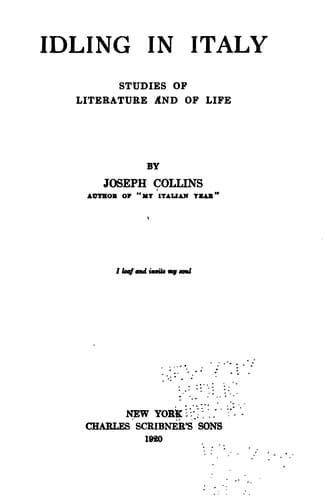
Idling in Italy: Studies of literature and of lifeCollins, Joseph
History
Idling in Italy: Studies of literature and of life
Collins, Joseph
Italian literature -- History and criticism
His fame as a poet being established to his own satisfaction he turned
to the field of romance, and in the next five years (1893-1898) there
flowed from the printing-presses a series of romances that veritably
flooded literary Italy: "L'Innocente," "Il Piacere," "Giovanni
Episcopo," "Trionfo della Morte," "Le Vergini delle Rocce," "Forse che
si forse che no," and the "Novelle della Pescara." They had a quality
that is not easily characterized by word or brief description. They were
"sensuous," "decadent," "daring," "shocking," "brilliant." They were
modelled on Flaubert, Prevost, Huysmans; they were saturated with the
philosophy of Nietzsche, the psychology of Ibsen, the mysticism of
Maeterlinck, the morality of Petronius; they reek of the bestialities of
Wilde and Verlaine; they are the glorification of pagan ethics; they are
the apotheosis of lust. But they were read, discussed, admired, praised,
not only in Italy but the world over. I doubt that praise was ever given
so lavishly, so widely, and so unjustifiably as was given to this series
of romances, which to-day, a generation after their publication, are as
constant a reminder of a wayward step which Italian literature took at
the end of the nineteenth century as the linea alba on the torso of a
woman whose reputation for virtue is established and admitted reminds
her of a faux pas of her youth.
In these volumes the author showed that he had a marvellous capacity to
depict states of exalted sensibility; that he had an extraordinary,
almost superhuman sensitiveness to beauty as it is revealed in nature
and in art; that he had a clairvoyant knowledge of the activity of the
unconscious mind of human beings and how it conditions their behavior
under circumstances and environments fortuitous or chosen--in other
words, until it is revealed to them behavioristically; that he had a
comprehensive familiarity with plastic and pictorial art; an intimacy
with ancient history and modern literature that was stupendous, and
withal a capacity to externalize his visions, his emotional elaboration,
and his mental content in words so linked together that the very
juxtaposition of them is a pleasure to the eye and a satisfaction to the
soul.
But that which he knew best of all was the history of eroticism. Not
only was he familiar with its ancestry to the remotest time, but he had
guarded its infant days with such solicitude that he knew every
impression that worldly contact made upon its plastic consciousness, and
when it got its growth he set to work to ornament it so that contact
with it would be the apogee of all beauty, intimacy with it the purpose
of all ambition, union with it the object of all strife.
Public-domain text, read in full here on John Shaqi.
Reviews
Reviews
No reviews yet
Be the first to share your thoughts on this work.
Join the Discussion
Join the discussion
Sign in to leave a comment or review.
Sign InorCreate an account