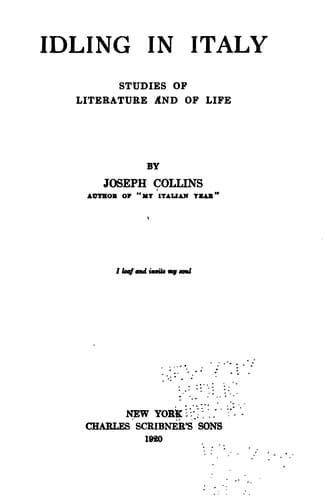
Idling in Italy: Studies of literature and of lifeCollins, Joseph
History
Idling in Italy: Studies of literature and of life
Collins, Joseph
Italian literature -- History and criticism
In "Songs of Achievements across the Sea" D'Annunzio established an
incontestable claim to be the great inspiring poet, even the prophet, of
his generation in Italy, and he produced work which has not been
surpassed, but he was still the poet only, singer of the deeds of
others, in which he had no share himself. The contrast between his
pretensions and his achievements made the affectations of his early
years appear ridiculous to many people, and tended to obscure the true
value of his work. He was still seeking and the years that followed in
Paris showed that he had discovered no new world to explore, but when
Italy joined the Allies he suddenly found himself. All the brooding
sense of incomplete achievement of other days vanished in a moment. The
speeches and addresses that he delivered between May 4 and 25, 1915,
showed that he had been preparing for what he knew would be "The Day"
for him.
It was widely believed in Italy in 1917 and 1918 that on the evening of
May 4, 1915, when D'Annunzio addressed a meeting at Quarto to
commemorate an anniversary of Garibaldi's departure with his faithful
thousand to deliver Sicily and Naples from the Bourbon yoke, and a few
days later when he addressed them in the Costanzi Theatre in Rome and
then went with the enormous crowd to ring the bell of the Campidoglio,
the signal was given for the declaration of war against Austria and
Germany.
The last books of D'Annunzio, illustrating his new attitude toward life,
are "La Leda senza-cigno" ("Leda without the Swan"), "Per la più grande
Italia" ("For Greater Italy"), "La Beffa di Buccari" ("Buccari's Joke"),
"La Riscossa" ("The Rescue"), "Bestetti e Tuminelli" ("Italy and
Death"), "Contro Uno e contro Tutti" ("Against One and against All"),
and a series of volumes under the title of "The Archives of Icarius,"
which are all concerned with incidents in the Great War.
It is too soon to attempt to guess the pedestal that posterity will
allot Gabriele D'Annunzio in the gallery of fame. The committee that
will do it will estimate his qualifications of lyric poet and Hellenic
dramatist--perhaps as warrior.
D'Annunzio is a poet who abounds in lyrical ecstacies. His style is the
most remarkable thing about him. He describes armor, architecture,
archæology like an expert. He knows the dynamic point of view. He knows
how to depict dramatic situations. His personages are all living
personages. He is concerned with the neurotic, decadent, hectic,
temperamental type of human beings. All his characters have a love of
beauty. He is the true decadent of the nineteenth-century literature, to
whom the decadent French symbolists cannot hold a candle.
Public-domain text, read in full here on John Shaqi.
Reviews
Reviews
No reviews yet
Be the first to share your thoughts on this work.
Join the Discussion
Join the discussion
Sign in to leave a comment or review.
Sign InorCreate an account