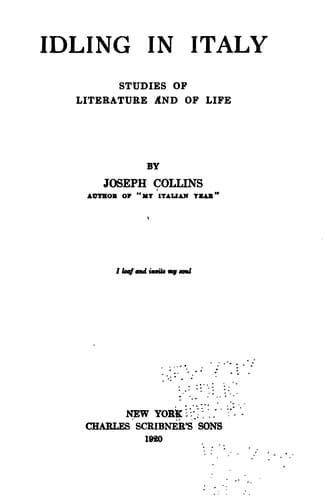
Idling in Italy: Studies of literature and of lifeCollins, Joseph
History
Idling in Italy: Studies of literature and of life
Collins, Joseph
Italian literature -- History and criticism
Apollinaire, a Pole whose real name was Kostrowitski, was born in Rome
and lived in Italy until late childhood, when he went to France, where
he remained until his death in 1919. He had a tremendous influence upon
many of the young symbolist writers of Italy, comparable to that
exercised by Stéphane Mallarmé on the young writers in the '80's and
'90's. One of them wrote at the time of his death: "Hero of thought and
of art, idealist, philosopher, genuine poet, prophetic theorist and
critic, sublime soul, comrade, joyous, generous, he was also in the last
years of his life a hero of humanity."
The most important figure of the school has been Giovanni Papini, who
has gathered about him in Florence a coterie which includes Ardengo
Soffici, the painter, critic, and novelist; Aldo Palazzeschi, poet;
Alberto Savinio, wanderer, musician, and litterateur; and a long list of
names more or less ancillary to Marinetti, some of which I shall mention
later.
Papini, who is considered at length in another chapter, does not admit
that he is a Futurist. As he puts it, he did not marry Futurism; it was
for him one of many intellectual adventures, a mistress that left an
indelible impression on him. He simply passed through Futurism's
influence and at the same time gave momentum to the best of that school,
to Palazzeschi, Govoni, Boccioni, Folgore. Then he proceeded alone,
after having become persuaded that it had become too popular and
consequently less refined and select, and after the hazardous and
aristocratic little group had become a species of low, bigoted democracy
into which any one could enter who dangled a rosary of incomprehensible
words. He left it in company with Soffici and Palazzeschi and soon Carrà
and others followed his example. Thus, on the death of Boccioni, the
first generation of Futuristic writers reformed or disappeared.
Then there are many young men carrying the banner of literature in Italy
to-day who do not call themselves Futurist, and whose writings contain
less of the grotesque, which has been made familiar to Italian readers
by Marinetti's "Zang Tumb Tumb." They are men of the stamp of Antonio
Beltramelli, Mario Mariani, Luigi Morselli, Gino Rocca, Salvator Gotta,
Lorenzo Montano, Vincenzo Cardarelli, Raffale Calzini, Enrico
Cavacchioli, Alfredo Grilli, and a score of others who not alone have
ideas but who keenly sense the composite world-thought, who believe that
the era of Big Business will reach its apogee when it weds Big Justice,
and who know how to express their ideas with explosive rhythmic
eloquence and with distinction of form.
Public-domain text, read in full here on John Shaqi.
Reviews
Reviews
No reviews yet
Be the first to share your thoughts on this work.
Join the Discussion
Join the discussion
Sign in to leave a comment or review.
Sign InorCreate an account