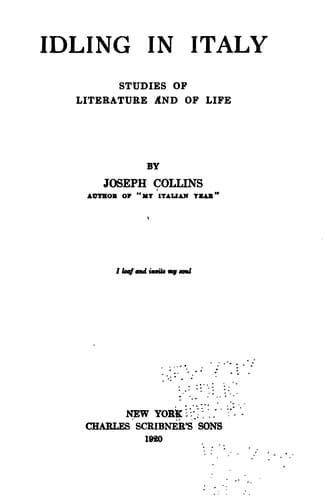
Idling in Italy: Studies of literature and of lifeCollins, Joseph
History
Idling in Italy: Studies of literature and of life
Collins, Joseph
Italian literature -- History and criticism
Giuseppina Guacci Nobile (1808-1848), of Naples, a contemporary of
Giusti, had great popularity as a poetess of sentiment. She sang of love
of country, of art, of husband, of children, of heaven, and when the
sadness of the times was so profound that she needs must sing of hate
she died.
Three poets of northern Italy must also be mentioned. Francesco
Dall'Ongaro, who, though born in the Friuli, went to Venice when he was
ten years old and lived for the rest of his life in the northern
provinces, had a tremendous popularity in the revolutionary period of
1848 because of a little collection of lyrics called "Stornelli";
Giovanni Prati, of Dasindo, Trent, whose permanent reputation as a poet
depends upon his ballads, became widely known through his poem
"Edmenegarda"; and Aleardo Aleardi, born at Verona in the early years of
the nineteenth century, whose best-known book, "Le Prime Storie," was
extensively read.
The pillars of the romantic movement were soon erected in Central Italy
by the writings of Leopardi, Niccolini, and Giusti.
Giacomo Leopardi (1798-1837) had a personality that has fastened itself
upon Italy, even unto the present day, in a most extraordinary--one
might even say, inexplicable--way. He was laconic, silent, morose,
introspective, solitary, celibate. His filial love was readily
overdrawn; he loathed his ancestral home and environment; he contended
with ill health from infancy; he was denied the understanding friend,
save one, whose behavior toward Leopardi has been criticised severely.
He wandered solitarily about central Italy wrapped in the mantle of
introspection and veiled in melancholy until 1833, when he settled at
Naples, and there he remained four years, until he had attained his
thirty-ninth year, when he died under most distressing circumstances.
Ranieri, in his "Sette Anni di Sodalizio con Giacomo Leopardi," gives
this description of Leopardi's appearance: he was of moderate height,
bent and thin, with a fair complexion that inclined to pallor, a large
head, a square, broad forehead, languid blue eyes, a short nose, and
very delicate features; his voice was modest and rather weak; his smile
ineffable and almost unearthly.
Public-domain text, read in full here on John Shaqi.
Reviews
Reviews
No reviews yet
Be the first to share your thoughts on this work.
Join the Discussion
Join the discussion
Sign in to leave a comment or review.
Sign InorCreate an account