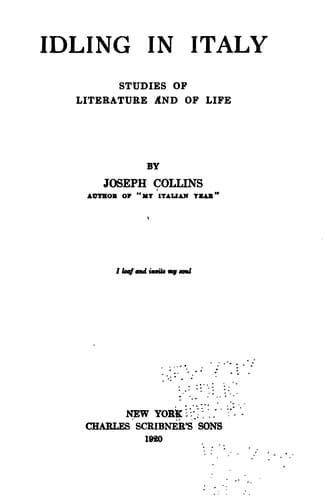
Idling in Italy: Studies of literature and of lifeCollins, Joseph
History
Idling in Italy: Studies of literature and of life
Collins, Joseph
Italian literature -- History and criticism
No one can examine closely the writings of Signor Papini without
recognizing that he has shown himself incapable of selecting from that
which he has written and thought and of setting it forth as a statement
of his philosophy or as an Apologia pro Sua Vita. Constant republication
of the same statements and the same ideas dressed up with different
synonyms is a charge that can be brought with justice. It can be
substantiated not only by his books but by _La Vraie Italie_, an organ
of intellectual liaison between Italy and other countries directed by
Signor Papini, which had a brief existence in 1919, a considerable
portion of which was taken up with republication of the old writings of
the director.
Even the most intemperate of his admirers would scarcely contend that he
merits being called original, judged by his own standards. At one time
in his life Nietzsche was undoubtedly his idol, and I can think of the
juvenile Papini No. 3 suggesting that he model himself after the
Teutonic descendant of Pasiphae and the bull of Poseidon. Thus did he
appease his morbid sensitiveness and soothe his pathological erethism by
enveloping himself in an armor made up of rude and uncouth words, of
sentiment and of disparagement; of raillery against piety, reverence,
and faith; of contempt for tradition. In fact, he seemed equipped with a
special apparatus for pulling roots founded in the tender emotions. He
would pretend that he is superior to the ordinary mortal to whom love in
its various display, sentiment in its manifold presentations, dependence
upon others in its countless aspects are as essential to happiness as
the breath of the nostrils is essential to life. In secret, however, he
is not only dependent upon it, he is beholden to it.
When he assumes his most callous and indifferent air, when he is least
cognizant of the sensitiveness of others, when in brief he is speaking
of his fellow countrymen, Signore D'Annunzio, Mazzoni, Bertacchi, Croce,
and up until recently when he speaks of God or religion, he reminds me
of that extraordinary and inexplicable type of individual whom we have
had "in our midst" since time immemorial, but who had greater vogue in
the time of Petronius than he has to-day.
Although the majority of these persons are _au fond_ proud of their
endowment, the world at large scoffs at them; and in primitive countries
such as our own it kicks at them; therefore they are quick to see the
advantage of assuming an air of crass indifference and, with the swagger
of the social corsair, to express a brutal insensitiveness to the
æsthetic and the hedonistic to which in reality they vibrate. They never
deceive themselves, and Signor Papini does not deceive himself. He knows
his limitations, and the greatest of them are that he is timid, lacking
in imagination, in sense of humor, and in originality. He is as
dependent upon love as a baby is upon its bottle.
Public-domain text, read in full here on John Shaqi.
Reviews
Reviews
No reviews yet
Be the first to share your thoughts on this work.
Elsewhere in the archive
Join the Discussion
Join the discussion
Sign in to leave a comment or review.
Sign InorCreate an account