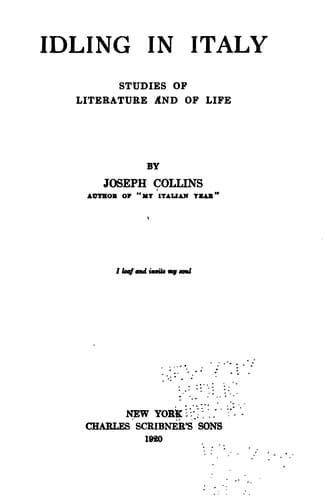
Idling in Italy: Studies of literature and of lifeCollins, Joseph
History
Idling in Italy: Studies of literature and of life
Collins, Joseph
Italian literature -- History and criticism
When writing about himself he hopes the reader will identify him only
with the characters whose thoughts and actions are flattering, but the
real man is to be identified with some of the characters whom he desires
his public to think fictitious. In one of his short stories he narrates
a visit to a world-famed literary man. He describes his trip to the
remote city that he may lay the modest wreath plated from the pride of
his mind and his heart at the feet of his idol. He finds him a
commonplace, almost undifferentiated lump of clay with a more
commonplace, slatternly wife and even more hopelessly commonplace
children. His repute is dependent wholly upon the skill with which he
manipulates a card index and pigeon-holes. Papini fled to escape
contemplation of himself and the fragments of the sacred vessel.
Signor Papini has been an omnivorous reader along certain lines; he has
been a tireless writer, and he is notorious for his neologistic
logorrhea, but the possession which stands in closest relation to his
literary reputation is his indexed collection of words, phrases, and
sentences. This, plus knowing by heart the poetry of Carducci, and his
envy of Benedetto Croce for having obtained the repute of being one of
the most fertile philosophic minds of his age, and his advocacy of the
gospel of strenuousness, is the framework upon which he has ensheathed
his house of letters.
No study of the man or of his work can neglect one aspect of his
career--his constant change of position. He knocks with breathless
anxiety at the door of some new world, and no sooner does he secure
entrance and see the pleasant valley of Hinnom than he feels the lure of
black Gehenna and is seized with an uncontrollable desire to explore it.
When he returns he hastens to the public forum and announces his
discoveries, preferring to tell of the gewgaws which he discovered than
to expatiate on the few jewels which he gathered.
His last production augurs well for him, because it indicates that
finally he will bathe in the pool of the five porches at Jerusalem, the
World War having troubled its water instead of an angel. November 30,
1919, he published in the most widely circulated and influential
newspaper of Central Italy, the _Resto del Carlino_, an article entitled
"Amore e Morte" ("Love and Death"), which sets forth that he has had
that experience which the Christian calls "seeing a great light, knowing
a spiritual reincarnation," and which those whom Papini has been
supposed to represent call a pitiable defalcation, a spiritual
bankruptcy.
Public-domain text, read in full here on John Shaqi.
Reviews
Reviews
No reviews yet
Be the first to share your thoughts on this work.
Elsewhere in the archive
Join the Discussion
Join the discussion
Sign in to leave a comment or review.
Sign InorCreate an account