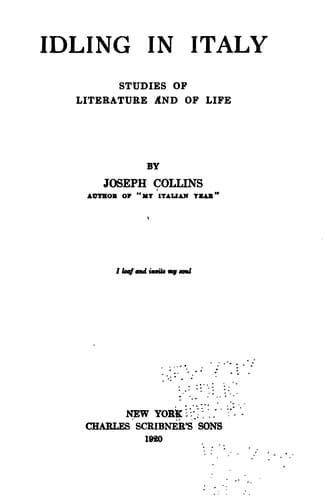
Idling in Italy: Studies of literature and of lifeCollins, Joseph
History
Idling in Italy: Studies of literature and of life
Collins, Joseph
Italian literature -- History and criticism
This period of hyperactivity is invariably followed by a time of
depression, of inadequacy, of emotional barrenness, of intellectual
sterility, of physical impotency, of spiritual frigidity. The sun from
which the body and the soul have had their warmth and their glow falls
below the horizon of the unfortunate's existence and he senses the
terrors of the dark and the rigidity of beginning congelation. Then,
when hope and warmth have all but gone and only life, mere life without
color or emotion remains, and the necessity of living forever in a world
perpetually enshrouded in darkness with no differentiation in the débris
remaining after the tornado, then the sun gradually peeps up,
illuminates, warms, revives, fructifies the earth, and the sufferer
becomes normal--normal save in the moments or hours of fear when he
contemplates having again to brave the hurricane or to breast the
deluge. But once the wind begins to blow with a velocity that bespeaks
the readvent of the tornado, he throws off inhibition and goes out in
the open, holds up the torch that shall light the whole world, and with
his megaphone from the top of Helicon shouts: "This way to the
revolution."
In a relative sense, this is the mode of Signor Papini. He is fascinated
by the beauty and perfections of an individual or of a school and he
will enroll himself a member, but before he gets thoroughly initiated he
gets word of another individual or another school which must be
investigated. In the intoxication he defames and often slays his
previous mistress. Thus his whole life has been given to the task of
discovering a new philosophy, a new poetry, a new romance, a new
prophecy, and their makers. In the ecstasy of discovery he cannot resist
smashing the idol of yesterday that his pedestal may be free for the
more worthy one of to-day, and he cannot inhibit the impulse to rush off
to the composing-rooms of _La Voce_ to register his emotions in print.
In his desire to be famous he reminds one of those individuals who would
be liked by every one, and who will do anything save cease making the
effort. Pretending that he loves to have people hate him, he does not,
but he would rather have hate and disparagement than indifference or
neglect. He desires power, that unattainable he will be satisfied with
notoriety. He does not agree with a fellow poet that
"On stepping stones we reach to higher dreams,
And ever high and higher must we climb,
Casting aside our burdens as we go,
Till we have reached the mountain-tops sublime,
Where purged from care and dross the free winds flow."
Public-domain text, read in full here on John Shaqi.
Reviews
Reviews
No reviews yet
Be the first to share your thoughts on this work.
Elsewhere in the archive
Join the Discussion
Join the discussion
Sign in to leave a comment or review.
Sign InorCreate an account