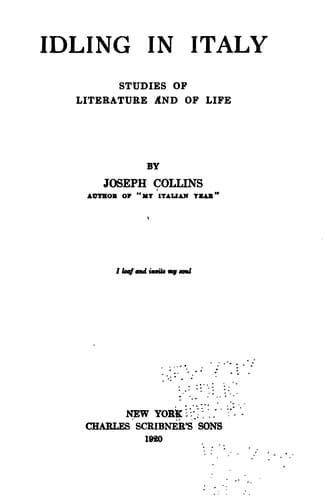
Idling in Italy: Studies of literature and of lifeCollins, Joseph
History
Idling in Italy: Studies of literature and of life
Collins, Joseph
Italian literature -- History and criticism
His writings display an intimate familiarity with a few classic writers,
especially of Greece and Italy, which he reveals by frequent and
appropriate quotations and references, contrasting the sayings and
doings of the venerated ancients with those of the not always deprecated
modern. He knows the emotional desires and reactions of the average man;
he senses his aspirations and his appeasements; he has keen
understanding of his virtues and his infirmities. He knows his potential
and actual pleasures, and he reveals this understanding of his fellows
to us in a diverting and instructive way and at the same time shows us
idealistic vistas of life and conduct that are most refreshing. It is to
be regretted that he is not equally enlightened about women. If he knows
their aspirations he denies the legitimacy of them; if he discerns their
future he refuses to forecast it; if he knows feminine psychology his
writings do not reveal it. He is the traveller ascending from the plains
whose pleasure is in looking backward to survey the paths over which he
has travelled, to describe the beauty of the country and its
associations, and to moralize about them. Elevations in front of him
from which one may legitimately anticipate more comprehensive vistas he
refuses to consider, or, if constrained to do so, denies that what shall
be seen from them will compare with what he sees and has seen.
His two most successful and commendable books are "La Lanterna di
Diogene" ("Diogenes' Lantern") and "Xantippe." The first is a narrative
of sentimental wandering in which he describes the commonplace world and
the homely conflict of those whom he encounters, and in which he
displays not only tolerance, but love of his fellow men. He is sometimes
playful, more often ironical, but never disparaging or vituperative, and
his prose is clear, limpid--sometimes, indeed, sparkling.
His "Xantippe" does not deal particularly with the virtues or
infirmities of that renowned shrew. It recounts many incidents in the
life, trial, and incarceration of Socrates which, while still redounding
to his fame, are made to show by contrasting them with man's conduct and
customs to-day the weaknesses, inconsistencies, and fallacies of many
conventions of the twentieth century.
"Il Viaggio di un Povero Letterato" ("The Wanderings of a Poor Writer")
shows the same simple-minded, charming vagabondage as "Diogenes'
Lantern." It was published in 1912, when many readers did not share his
distrust of Germany or hold with him in his forecasts. Many of his
statements are to-day prophecies fulfilled.
Public-domain text, read in full here on John Shaqi.
Reviews
Reviews
No reviews yet
Be the first to share your thoughts on this work.
Elsewhere in the archive
Join the Discussion
Join the discussion
Sign in to leave a comment or review.
Sign InorCreate an account