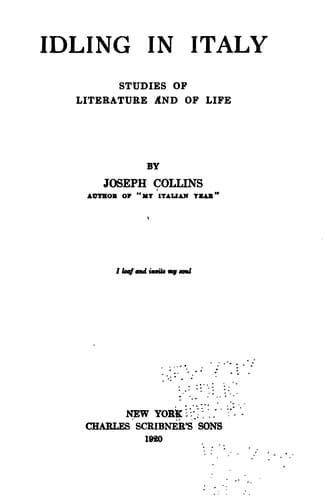
Idling in Italy: Studies of literature and of lifeCollins, Joseph
History
Idling in Italy: Studies of literature and of life
Collins, Joseph
Italian literature -- History and criticism
It is not an imaginary man of letters who starts on a trip in obedience
to a doctor's orders. It is Alfredo Panzini, exhausted from many labors.
He goes wherever his fancy takes him, to Vicenza, Bologna, Pisa, Venice,
and it is with the literary memories of these places that he is chiefly
concerned. At Pisa it is Leopardi, Shelley, and Byron; at Vicenza,
Fogazzaro; but at Bologna the memories become more personal. Here he sat
at the feet of Carducci and learned to love and respect him; here his
budding fancies first showed indications of blooming; here he first
essayed amatory flights. He chances upon an old flame of his student
days leading the old life in the old home, except that she had taken to
writing poems and insists on having his opinion of them. His account of
how he succeeded in meeting her wishes and still maintained his
self-respect is a masterpiece of ingenuousness. The least thing suffices
to start a train of thought and reflection or to decide his next
tarrying-place. The volume ends with an interesting account of a visit
to the birthplace of Pascoli, the socialist and idealist poet of the
Romagna.
In his "Piccole Storie del Mondo Grande" he describes a pilgrimage to
the country of Leopardi, and to Umbria. It is filled with little
anecdotes of literary immortals who wandered there, and of references
that are more significant to Italians than to foreigners, and through it
all there is a strange, melancholy humor which is quite characteristic
of Panzini.
The two novels which he has written show that he has the art of the
story-teller in narration, sequence, and constructiveness, but they lack
what the dramatists call action. "Io Cerco Moglie" ("I Seek a Wife") is
his best work. Ginetto Sconer, who oozes prosperity and
self-satisfaction, proceeds in a businesslike way to select a wife. He
consults a pastry-cook and a doctor, to the great glee of the reader. He
sees women in three categories: those who presume to disturb the dreams
of anchorites and are still men's pleasure and despair; the aristocratic
blue-stocking; and the domestic paragon. He had not contemplated
marrying a blue-stocking or even aspiring to blue blood, but when he
meets Countess Ghiselda he realizes that ambition expands with amatory
awakement. Her freedom is handicapped by the attentions of a Futuristic
poet whose intellectual productions and antics are amusing to every one
save Cavaliere Sconer. He has peeps into spiritual and emotional vistas,
but he yields finally to the flesh-box and woos the daughter of the
woman who places a caramel in the mouth of her husband every morning
before he goes to his office.
Signor Panzini knows the present-day Borghese, their thoughts, their
virtues, their absurdities, and their charm, and he has depicted them in
this book in the most interesting way.
Public-domain text, read in full here on John Shaqi.
Reviews
Reviews
No reviews yet
Be the first to share your thoughts on this work.
Elsewhere in the archive
Join the Discussion
Join the discussion
Sign in to leave a comment or review.
Sign InorCreate an account