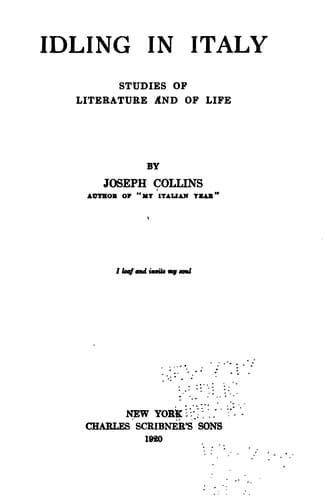
Idling in Italy: Studies of literature and of lifeCollins, Joseph
History
Idling in Italy: Studies of literature and of life
Collins, Joseph
Italian literature -- History and criticism
get the full effect of these paradoxes and analyses the closest
attention of the reader and of the auditor is required, and as a matter
of fact Pirandello's comedies read much better than they play. Those who
know maintain that he has little capacity for stage technic, that he
knows nothing of the art of the stage. Hence his comedies have not had
the success of Giacosa and of Bracco.
As human documents they depend upon their humor and veiled irony more
than upon any other qualities. The humor, which seems to be obtained by
simple means, is nearly always the result of an analysis so fine, so
subtle, that sometimes one loses track of the premises on which it is
founded. He compels the attention of his reader and he makes him think.
Without such attention and thought the subtleties of Pirandello often
escape the reader. Sometimes he labors a point almost to a tiresome
degree, for instance, in the play "Così è se vi pare" ("It's so if You
Think It's so"). The central point is the identity of a woman, which
would seem, to the average individual, could be established readily
beyond peradventure, but the point is--is there anything that can be
established beyond peradventure? Is there any such thing as literal
truth? Is not truth in reality synonymous with belief, individual or
collective, or both? Discussion of questions of this sort may become
very tiresome, but Pirandello has the art of mixing them up with human
weaknesses and human virtues which makes the mixture not only palatable
but appetizing. In his last comedies--"Il Giuoco delle Parti" ("Each One
Plays His Own Rôle") and "Ma non è una Cosa Seria" ("But It isn't a
Serious Matter")--he reverts to matrimonial tangles and attempts at
disentanglement, depicting in the former the "temperamental" woman who
gets what she wants, but who finds when she gets it she does not want
it, and the long-suffering husband who is discerning enough to know how
to handle her by conceding what she demands that he may get what he
should have.
The man who usurps the conjugal privileges of the husband must also
discharge his obligations. So it transpires when his temperamental wife
has been insulted by some intoxicated gilded youths who by their conduct
in her house provoke a scandal in the neighborhood, it is necessary for
the _de facto_ husband to challenge the most aggressive of them to a
duel. During the excitement of the preparation the happy thought comes
to him to have the vicarious husband fight the duel. He does so and is
killed. The cause of all the trouble, the lady, is quite ignorant of
this arrangement and thinks the _de facto_ husband is battling with the
most invincible sword of the city and that he will get killed, which is
her desire. On returning to her house she finds her husband lunching as
if nothing unusual had happened. The dramatic climax soon comes when she
scornfully taunts him with having some one fight a duel for him and he
replies: "Not for me but for you."
Public-domain text, read in full here on John Shaqi.
Reviews
Reviews
No reviews yet
Be the first to share your thoughts on this work.
Elsewhere in the archive
Join the Discussion
Join the discussion
Sign in to leave a comment or review.
Sign InorCreate an account