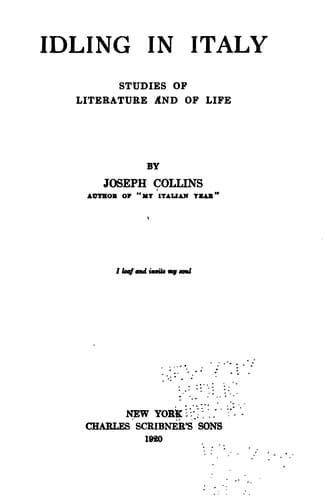
Idling in Italy: Studies of literature and of lifeCollins, Joseph
History
Idling in Italy: Studies of literature and of life
Collins, Joseph
Italian literature -- History and criticism
The play gives Pirandello the opportunity to display his knowledge of
the sentiments and passions of the modern "high life" individual.
Although they talk and act and express familiar sentiment in a way that
makes one think they are real people, in reality they are unreal. They
are taken from the author's imagination rather than from real life.
The second comedy in this volume is much more meritorious than the
first. The author portrays characters who well might have existed in the
flesh. Gasparina, who has put twenty-seven years of continency behind
her and had achieved the direction of a second-class boarding-house, is
derided and maltreated by her "guests." The most swagger of her
boarders, who has been miraculously saved in a duel which followed a
broken engagement, has an original idea. He will make a mock marriage
with her and thus establish freedom from further love, annoyance, and
duels. She sees in the proposal escape from the boarding-house. In the
little villa of the country to which he sends her, under promise that
she is not to make herself evident and where he is not to visit her, she
blooms like a flower. In due course of time he falls in love again, and
in order that he may accomplish matrimony he must free himself from
Gasparina. This could be accomplished, as it never was consummated, but
the messenger, an old aspirant to her favor, is on the point of having
his aspirations realized when the husband in name only sees in Gasparina
the woman he really loves. The curtain falls at an opportune moment
before any hearts are broken or any blood is shed.
It is one of the plays of Pirandello that has had considerable success
on the stage.
He is in reality a finished workman, an accomplished stylist, a happy
colorist, and fecund withal. His most important of the stories are "Erma
bifronte" ("Deceitful Hermes"), "La Vita Nuda" ("Naked Life"), "La
Trappola" ("The Snare"), "E Domani ... lunedi" ("And
To-morrow--Monday"), "Un Cavallo Nella Luna" ("A Horse in the Moon"),
"Quand ero matto" ("When I was Crazy"), "Bianche e Nere" ("Blacks and
Whites"); his romances, in addition to the ones already mentioned, are
"I Vecchi e I Giovani" ("The Old and the Young"), and "Si Gira" ("One
Turns"), the most recent and poorest of them.
It would be a mistake to convey the impression that Pirandello is
universally admired in Italy. His stories and romances have an
adventuresome quality that transcend ordinary experience, and his plays
attempt to dispense with theatricalness and to substitute for it a
subtle analysis of life with corrosive comment, both of which are very
much resented.
Public-domain text, read in full here on John Shaqi.
Reviews
Reviews
No reviews yet
Be the first to share your thoughts on this work.
Elsewhere in the archive
Join the Discussion
Join the discussion
Sign in to leave a comment or review.
Sign InorCreate an account