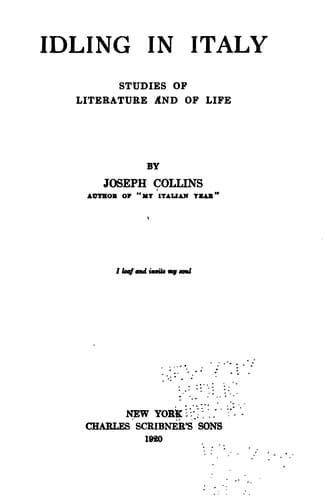
Idling in Italy: Studies of literature and of lifeCollins, Joseph
History
Idling in Italy: Studies of literature and of life
Collins, Joseph
Italian literature -- History and criticism
Among the fiction that has appeared in Italy during the past year a few
books call for mention, not because of their intrinsic merit but because
it is indicative of the change that is going on in the minds of the
common people which reflects particularly the thought now being given to
social and psychological questions.
The American reader of Italian fiction cannot fail to be impressed with
the poverty of subject-matter which it displays. This is explained
partly by the fact that it is sometimes biographical and very often
autobiographical--moreover, the family and social and religious customs
of Italy do not make for novelty or variety in individual life. The zone
in which all the details of existence is predetermined by convention
extends much farther with them both up and down the social scale than
with us. If man is independent of it to some extent woman is not, and
since there is no object in chronicling the obvious, popular Italian
fiction is apt to deal with excursions of man beyond his own circle and
class. Another thing that has to be kept in mind is the position of
women. The important woman in the life of the majority of Italians is
the mother, not the wife. She is on terms of equality with her son and
she retains much of the authority of the Roman matron in her children's
married life. This it need scarcely be said is changing with the eternal
flux of things.
Italy of to-day is a very new country. Whenever we as a nation do
something which the Italians consider gauche or raw, and they are
obliged to dislocate an inherent politeness by mention of it, they
excuse us because we are so young. So one excuses an infant for some
verbal or conductual infraction. In reality we are about a century older
than Italy of to-day, and we have spent that time developing a "manner"
that reflects our protracted habituation to freedom. That it is
sometimes masked by arrogance and self-satisfaction is to be regretted.
Hence our indifference to convention which is often painful to the
foreigner. It is a mistake to think that it is only the upper classes of
Italy who are beholden to unwritten convention and customs. In truth,
subscription to them is more mandatory amongst the Borghesia and Il
Popolo. With the gradual dissemination and acceptation of the doctrines
of socialism, the equal rights of women, and the widening sphere of
culture through universal education, many of the shackling conventions
of to-day will disappear. The younger workers are blazing the way. Of
those who herald this change Mario Mariani must be heeded. In "La Casa
dell' Uomo" ("The House of Man"), he makes a satiric onslaught against
the amorous, avid of money and of pleasure, who are ready to sacrifice
every basic virtue in order to obtain them. After presenting a picture
of the present-day cages of human beings he tells his story through the
mouth and diary of the janitress of a modern apartment-house, who being
deprived by time of her pulchritude and sensuous appeal, has been
Public-domain text, read in full here on John Shaqi.
Reviews
Reviews
No reviews yet
Be the first to share your thoughts on this work.
Elsewhere in the archive
Join the Discussion
Join the discussion
Sign in to leave a comment or review.
Sign InorCreate an account