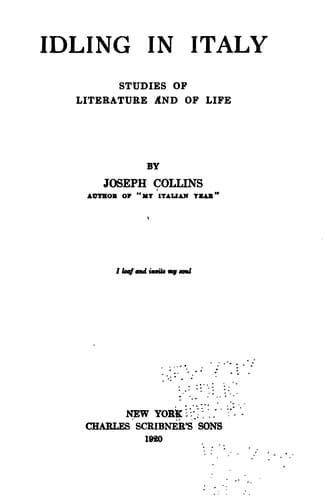
Idling in Italy: Studies of literature and of lifeCollins, Joseph
History
Idling in Italy: Studies of literature and of life
Collins, Joseph
Italian literature -- History and criticism
obliged to forego her chosen profession, that of Mrs. Warren, and to
gain her livelihood in the sweat of her brow. She has visions of a day
when she can no longer even do that, and yet must needs have food,
raiment, and shelter; so she keeps a diary which sets forth the
flagrancies of the tenants, men, women, and children. She does not admit
that the entries are the wythes of blackmail. She salves such conscience
as has survived her life of sin by assuring herself that the entries in
the book are to assuage literary growing pains. When Signor Mariani
obtained the documents by fabrication or by stealth he found himself in
possession of the "characters" of many individuals, young and old, who
present a strange similarity to those we encounter in daily life. He has
seen fit to publish them without saying whether it was art or bread that
was the incentive, and they constitute a serious charge against society.
The wonder is that if such things exist the social fabric conserves the
appearance of well-being. In truth, life is not a mask behind which the
wearer laughs, if this diary is to be believed. It is in reality a
tragedy made up of a tissue of hypocrisies, banalities, sordid
commonplaces, inimical to joy, subversive of pleasure, and destructive
of happiness.
It is obvious that de Maupassant is the author's model. Despite a
certain vivacity of form, his tales are in substance very old-fashioned
and his characters are so sordid and sensual that their actions and
their fate from an artistic point of view fail to interest.
In "Smorfia dell' anima" ("Grimaces of the Soul"), the central theme is
that all people who defy accepted morals are much more honest and happy
than those who hypocritically accept convention but do not conform to
the moral laws which underlie them. There is a certain amount of truth
in this view, but it will not stand too much insistence.
Though Signor Mariani's books are not entitled to laudation, they, with
his commentual writing, encourage us to await the advent of his full
powers with a sincere belief that he will arrive in Italian letters.
Public-domain text, read in full here on John Shaqi.
Reviews
Reviews
No reviews yet
Be the first to share your thoughts on this work.
Elsewhere in the archive
Join the Discussion
Join the discussion
Sign in to leave a comment or review.
Sign InorCreate an account