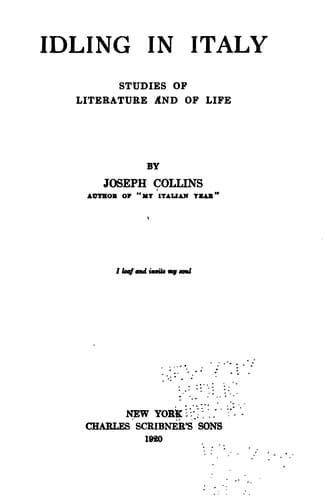
Idling in Italy: Studies of literature and of lifeCollins, Joseph
History
Idling in Italy: Studies of literature and of life
Collins, Joseph
Italian literature -- History and criticism
I find greater difficulty in writing of recent Italian poetry than of
fiction. In the first place, I have not read it so extensively, and, in
the second, nearly every writer of fiction writes poetry as well. Some
of the young poets are discussed in the chapter on Futurists in
literature. Here I shall mention one or two others. Guido Gozzano, who
recently died, in his twenty-eighth year, was a prolific writer of
verse. It is confidently claimed by some critics that he earned the
distinction of being called Italy's most representative poet, the only
one since Pascoli and D'Annunzio who made a new vibration to the poetic
lyre and stamped verse with an individual conception which poetasters
have more or less accepted. But he suffered from hyperfecundity, and
many of his intellectual children are anæmic and rachitic. Even though
they are endowed with some feature of beauty their vitality is so slight
that no one wants to adopt them, and their parent being busy with the
creation of others, neglects them after having given them one passably
decent suit of clothes in the shape of book-form publications, so they
die.
Guido Gozzano was a melancholy figure. From life he appeared to have got
only sadness. At twenty-five years it had deluged his soul. His true
infelicity was then of not being able even to be sad. Scarcely had he
entered youth before he felt old. He had no companions, he was often
ill; nothing appealed to him, not even poetry. Literary life resembled
death. He forsook the city for the country, and the novelty of it for a
while diverted him. But it was not for long. He vacillated between doing
nothing and dreaming, between contemplating the emptiness of a grotesque
reality and the nostalgia of an unreal life, felt but not seen. He was
never emotional, never exalted, never blasphemous. Nevertheless, he
would seem to have written incessantly.
"Verso la Cuna del Mondo" ("Toward the Cradle of the World") consists of
the impressions of a voyage in India made in 1912 and 1913. "I Colloqui"
is a book of fables for children. In the "L'Altare del Passato" ("The
Altars of the Past") Gozzano takes as a rhythm the cry for the things
that were; the past arises anew in the intimacy of his feelings to tempt
him and to inspire him. It is the generous wine that he hopes will
intoxicate him and fill him with joy. Its effects are transitory.
His last book, "L'Ultima Traccia" ("The Last Traces"), did not
materially enhance his reputation as a story-teller. The story called
"The Eyes of the Soul" is undoubtedly the best. A beautiful girl has to
live her betrothed days alone; her fiancé goes to the war. She contracts
smallpox, which disfigures her. When she is called to his bedside in the
hospital where he is lying wounded, perhaps dying, she is concerned what
his feelings will be when he sees her face. When she gets there he is
not mortally injured, he is blind.
Public-domain text, read in full here on John Shaqi.
Reviews
Reviews
No reviews yet
Be the first to share your thoughts on this work.
Elsewhere in the archive
Join the Discussion
Join the discussion
Sign in to leave a comment or review.
Sign InorCreate an account