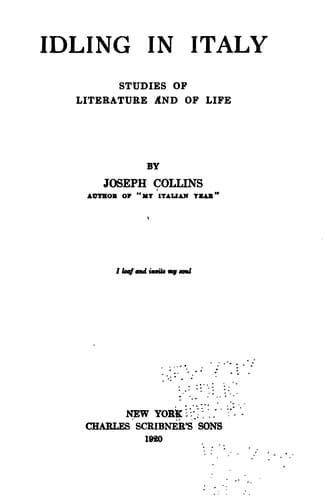
Idling in Italy: Studies of literature and of lifeCollins, Joseph
History
Idling in Italy: Studies of literature and of life
Collins, Joseph
Italian literature -- History and criticism
A writer who dyes his products in Bracco's vat, then for contrast colors
them with Sardou and Dumas, which, exposed for sale in the market-place,
find avid purchasers and bring high prices, is Dario Niccodemi, whose
comedies, especially "Scampolo" ("The Remnant") and "L'Ombra" ("The
Shadow"), have had great success. In his last two books, "Il Titano"
("The Titan") and "Prete Pero" ("Priest Pero"), he gives evidence that
he is keenly discerning of the new social consciousness that has
developed in Italy apparently as the result of the war. "Prete Pero,"
while depicting the subterfuges of the church to accomplish its ends and
the arguments that it uses to convince that the ends justify the means,
portrays one of those simple, faithful, honest, transparent souls, in
the shape of Father Bragio, who have been the pillars of the Roman
church which no Samson has ever been able to tear down. "I wrote 'Prete
Pero,'" he says, "as a journalist writes a series of articles or as a
speaker makes a series of conferences--for a general idea; but I have
had two, the first æsthetic, to sustain the principle that in Italy, as
in France and in England, and, indeed, in every country agonized by this
terrible war, one might make and make acceptably war comedies; second,
moral, to prove that it is permitted to say from the stage in verse or
in prose that which in the past four years has been said in journals, in
speeches, in conferences, in parliament and in committees, which is: in
the disorder of the social organization produced by the phenomena of war
there have been sublime heroes and brazen-faced cheats and swindlers."
"Prete Pero" showed that Signor Niccodemi has a nose for the favorite
perfume of the modern reader, just as his "L'Ombra" showed it when he
afflicted his heroine with hysterical paralysis and then cured her by
the method which Freud originally called the cathartic method. Dario
Niccodemi has not added materially to the dignity of Italian letters,
but he has amused and diverted his countrymen and ourselves, and for
that we are grateful.
Sem Benelli, who has recently had political life thrust upon him is, in
common with many literary Jews in Italy, inclined to give himself a
certain mystery of origin by concealing his antecedents. In reality he
was born in 1877. Not only is he well known in Italy but in this
country, where one of his early plays, "La Cena delle Beffe" ("The
Supper of the Jests"), has had great success. He began his literary
career as a journalist on a Florentine review, _Marzocco_. His first
play was published when he was twenty-five years old. Although "La
Tignola" ("The Moth") showed unusual quality of construction and
contrasted with great force the artistic temperament with the world of
the big business, it was not until "La Cena delle Beffe" that he
arrived.
Public-domain text, read in full here on John Shaqi.
Reviews
Reviews
No reviews yet
Be the first to share your thoughts on this work.
Elsewhere in the archive
Join the Discussion
Join the discussion
Sign in to leave a comment or review.
Sign InorCreate an account