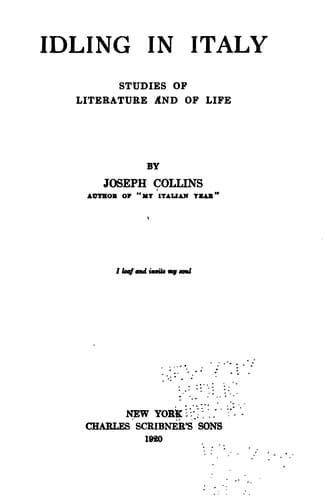
Idling in Italy: Studies of literature and of lifeCollins, Joseph
History
Idling in Italy: Studies of literature and of life
Collins, Joseph
Italian literature -- History and criticism
Signor Bracco, a Neapolitan approaching sixty years of age, has for the
past twenty years worn gracefully the mantle of Giacosa. His works have
been published in ten fat volumes averaging three plays to a volume,
mostly comedies. Of these the most important are "L'Infedele" ("The
Unfaithful Woman"), and "Il Trionfo" ("The Triumph"), both published in
1895. The best of his dramas are "Tragedie dell' Anima" ("The Tragedies
of the Soul") and "La Piccola Fonte" ("The Little Spring"), which
becomes the fount of life in inspiration for those with whom the heroine
comes in contact. The best of his tragedies is "Sperduti nel Buio"
("Lost in the Darkness"). This brief enumeration gives no idea of the
versatility of Signor Bracco, who in reality has depicted in his
twoscore plays the ravages of carnal love in peasant and prince, in maid
and in mistress, in priest and professor, in the underworld and in the
overworld, in the cradle and in the grave.
Had the display of love and the passions that flow from it any confines,
they would encompass Signor Bracco's imagination. Although denied what
is called a scholastic education, he has studied science and philosophy,
literature and art, but always with one object in view: to learn what
human beings think and do when swayed by sexual passion. Not that
anything that he has written can be construed as exalting it or as
licensing it. On the contrary, the moral of the majority of his plays is
that continence, like virtue, is its own reward. Although Signor Bracco
would be the last to admit that he has not had an uplift motive in his
writings, it is difficult to discover it. Nor does he point the way that
will lead to avoidance of the suffering that flows, apparently with so
much directness, from social convention, from privilege, and from the
almost mediæval position of women in certain parts of Italy to-day. He
is a realist of realists in fiction, but he is like a physician who is
content to diagnose disease and leave to others its prevention and its
cure.
Public-domain text, read in full here on John Shaqi.
Reviews
Reviews
No reviews yet
Be the first to share your thoughts on this work.
Elsewhere in the archive
Join the Discussion
Join the discussion
Sign in to leave a comment or review.
Sign InorCreate an account