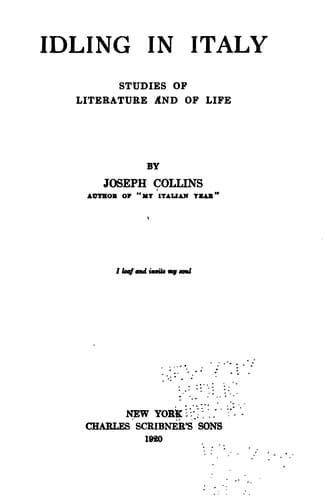
Idling in Italy: Studies of literature and of lifeCollins, Joseph
History
Idling in Italy: Studies of literature and of life
Collins, Joseph
Italian literature -- History and criticism
Every Johnson has his Boswell, though he may be mute, unrecording, and
sterile, and every sadist has his masochist. The young Dutchman, Vincent
Van Gogh, a constitutional psychopath, whose mental aberrations took him
into spiritual exhortation, social reformation, and finally "art," often
tried to kill Gauguin. When the latter showed himself versed in mayhem
Van Gogh made his bed, lit his pipe, wrapped himself in serenity and
shot himself in the abdomen, as lunatics often do. Not so Dick Stroeve,
Strickland's fidus Achates. He worshipped Strickland, who reviled him,
kicked him, spat upon him; Stroeve, who naïvely asks, "Have I ever been
mistaken?" in his estimate of artists, knew that Strickland was a great
artist, greater than Manet or Corot, more puissant than El Greco or
Cézanne, and that he had been sent to complete the cycle which Delacroix
and Turner ushered in. Stroeve, a passive, asexual creature, had married
a temperamental English governess in Rome, where he had earned the
soubriquet of "le Maître de la Boîte à Chocolats" after she had had a
disastrous experience with the son of an Italian prince whose children
she had been hired to instruct.
When Strickland falls desperately ill from the combined effects of
insufficient food, touting for prurient Anglicans, and translating the
advertisements of French patent medicines that "restore" Doctor
Maugham's countrymen to such a degree that they may go to Paris with
pleasurable anticipation, Stroeve takes him to his house, despite the
strenuous opposition and pathetic protests of Mrs. Stroeve, whose
previous fleeting contacts with Strickland echoed the call of the wild
in her and presaged disaster. From the moment he arrived the fat was in
the fire. No affinities are so difficult to keep from blending as sex
affinities, facetiously called soul affinities by the newspapers.
Strickland's spark was fanned lovingly into glow by Stroeve, and when it
flamed he threw Stroeve out of his house, possessed complaisant Mrs.
Stroeve violently, and then put her on canvas, nude, "one arm beneath
her head and the other along her body, one knee raised, the other leg
stretched out." After nature's cataclysm had spent itself, Mrs. Stroeve
committed suicide in approved feminine fashion by taking a corroding
acid, without condoning her husband's offense--that of being virtuous.
When she died Stroeve, a true masochist, looked up Strickland, forgave
him, invited him to go with him to Holland, because "we both loved
Blanche. There would have been room for him in my mother's house. The
company of poor, simple people would have done his soul a great good."
But Strickland, becoming for the moment verbally more expansive,
replied: "I have other fish to fry." When Mr. Maugham spoke to him about
Stroeve's visit he said: "I thought it damned silly and sentimental."
Public-domain text, read in full here on John Shaqi.
Reviews
Reviews
No reviews yet
Be the first to share your thoughts on this work.
Elsewhere in the archive
Join the Discussion
Join the discussion
Sign in to leave a comment or review.
Sign InorCreate an account