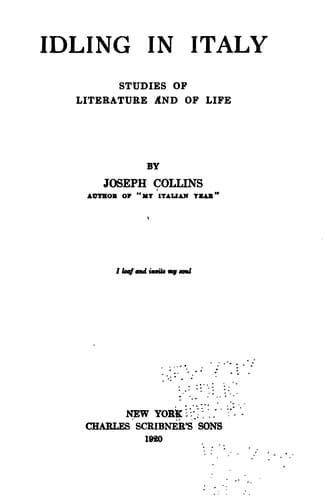
Idling in Italy: Studies of literature and of lifeCollins, Joseph
History
Idling in Italy: Studies of literature and of life
Collins, Joseph
Italian literature -- History and criticism
The author doesn't attempt a synopsis of the mental process that took
Strickland to Tahiti, via Marseilles, though he depicts experiences that
parallel those of Gauguin. Instead he animadverts on love and the sexual
appetite to such purpose as to reveal that he is not expert in biology,
psychology, or art. "For men love is an episode which takes its place
among the other affairs of the day, and the emphasis laid upon it in
novels gives it an importance which is untrue to life." But what about
the emphasis laid upon it by countless thousands who find in it a
quality of that ennobling spiritual peace called faith, and which will
be their reward when they repose in Abraham's bosom and live forever
with God in paradise? "As lovers the difference between men and women is
that women can love all day long, but men only at times." And the
difference between male and female animals is that the female of the
species permits contact at certain definite times, while the males are
all Barkises. "Art is a manifestation of the sexual impulse. It is the
same emotion which is excited in the human heart by the sight of a
lovely woman, the Bay of Naples under the yellow moon, and the
'Entombment' of Titian." After the author delivered himself of a
statement so pregnant of platitude he must have experienced a sense of
lightening, and a conviction that he would not have to consult the Drei
Abhandlungen zur Sexualtheorie at least until he wrote his next book.
That art has a definite purpose to perpetuate the creative will and that
God endowed his image with a genesic instinct that he might create and
thus reproduce his kind every one knows, but to contend that one is a
manifestation of the other is puerile, unenlightened, and harks back to
barbarism. One might think that there is no such thing as the psychology
of art or the science of æsthetics. Art has an intellectual significance
as well as, or more than, an emotional significance, and the
unfortunate, unhappy, disequilibrated man who is parodied in this book
contributed his substantial mite in the twentieth century to make us see
it.
Any one who reads the "Lettres de Paul Gauguin," which are prefaced by a
brief survey of his life by Victor Segalen, or his life by Jean de
Rotonchamps, which was published at Weimar at the expense of Count von
Kessler, will see how closely Maugham described Gauguin's life in the
Polynesian cannibal islands. Strickland marries the native girl Ata, who
had a "beguin" for him, but Gauguin had Tioka in his maison de joie
without benefit of clergy. Doctor Coutras, who gives Mr. Maugham so much
valuable information (via Rotonchamps and Segalen) is M. Paul Vernié,
who attended Gauguin and wrote an account of his last days.
Public-domain text, read in full here on John Shaqi.
Reviews
Reviews
No reviews yet
Be the first to share your thoughts on this work.
Elsewhere in the archive
Join the Discussion
Join the discussion
Sign in to leave a comment or review.
Sign InorCreate an account