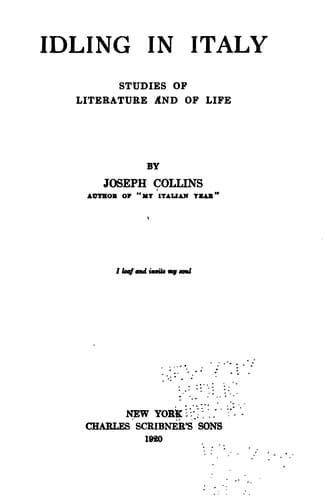
Idling in Italy: Studies of literature and of lifeCollins, Joseph
History
Idling in Italy: Studies of literature and of life
Collins, Joseph
Italian literature -- History and criticism
Despite the fact that in July, 1914, the London _Times_ lifted the veil
of secrecy from the face of the most prevalent disease in the world, and
thus announced that the name of the disease which Fracastorius, the
poet-physician of Verona, borrowed from the shepherd Syphlus should be
no longer taboo by "nice people," the prevalence of the disease and the
efforts to combat it have been widely discussed, though they are not
topics of conversation at dinner-parties or at "welfare meetings" in
churches, as tuberculosis is. It is for this reason, perhaps, that the
author prefers to kill his "hero" with leprosy. But Doctor Maugham has
been devoting so much of his time in latter years to novels and dramas
that he finds the differentiation between them difficult, and, too,
Gauguin's disease has been diagnosticated leprosy, elephantiasis,
syphilis. "La dernière de ces avaries est exacte, mais ne doit pas être
imputées au pays: c'était une pure vérole parisienne."
"The Moon and Sixpence" is interesting. There is scarcely any diversion
more engrossing than reading about others' infirmities unless it be
relating one's own. Hence the continued popularity of Pepys, Amiel,
Rousseau, Marie Bashkirsteff, and other garrulous sufferers. But it is a
book that no one can be the better or happier for reading, and it does
Gauguin's memory an injury because it parodies it. His life as it has
been revealed to us was bizarre and irregular enough. We could wish that
he had been less like Rimbaud and more like Rodin, but, distressing as
his behavior was, seen in conventional light, we should like not to have
seen it featured in fiction.
Mr. Maugham wrote a novel, "Out of Human Bondage," which is a far more
meritorious piece of work than "The Moon and Sixpence," in which some of
his professional colleagues--he is a physician--recognized portraitures.
Perhaps it was his success with them that encouraged him to try a larger
canvas.
The author's admitted cleverness was never more evident than in the
depiction of Mrs. Strickland's character and characteristics--a smug
Philistine, who runs the gamut of preciosity, jealousy, martyrdom,
autorighteousness, and autosanctification. She is pleased and proud as
she views the veneer of sanctimoniousness which her son, in holy orders,
gives the dearly beloved husband of Mrs. Charles Strickland, who wrote
his father's biography "to remove certain misconceptions which had
gained currency," viz., that Doctor Maugham is masquerading as a
psychiatrist and publishing his experiences with the insane, meanwhile
throwing off "punk" about art and traducing normal, though admittedly
"immoral," man.
Public-domain text, read in full here on John Shaqi.
Reviews
Reviews
No reviews yet
Be the first to share your thoughts on this work.
Elsewhere in the archive
Join the Discussion
Join the discussion
Sign in to leave a comment or review.
Sign InorCreate an account